
Foreign Assets Disclosure Scheme 2026 (FAST-DS): Eligibility, Tax & Key Details
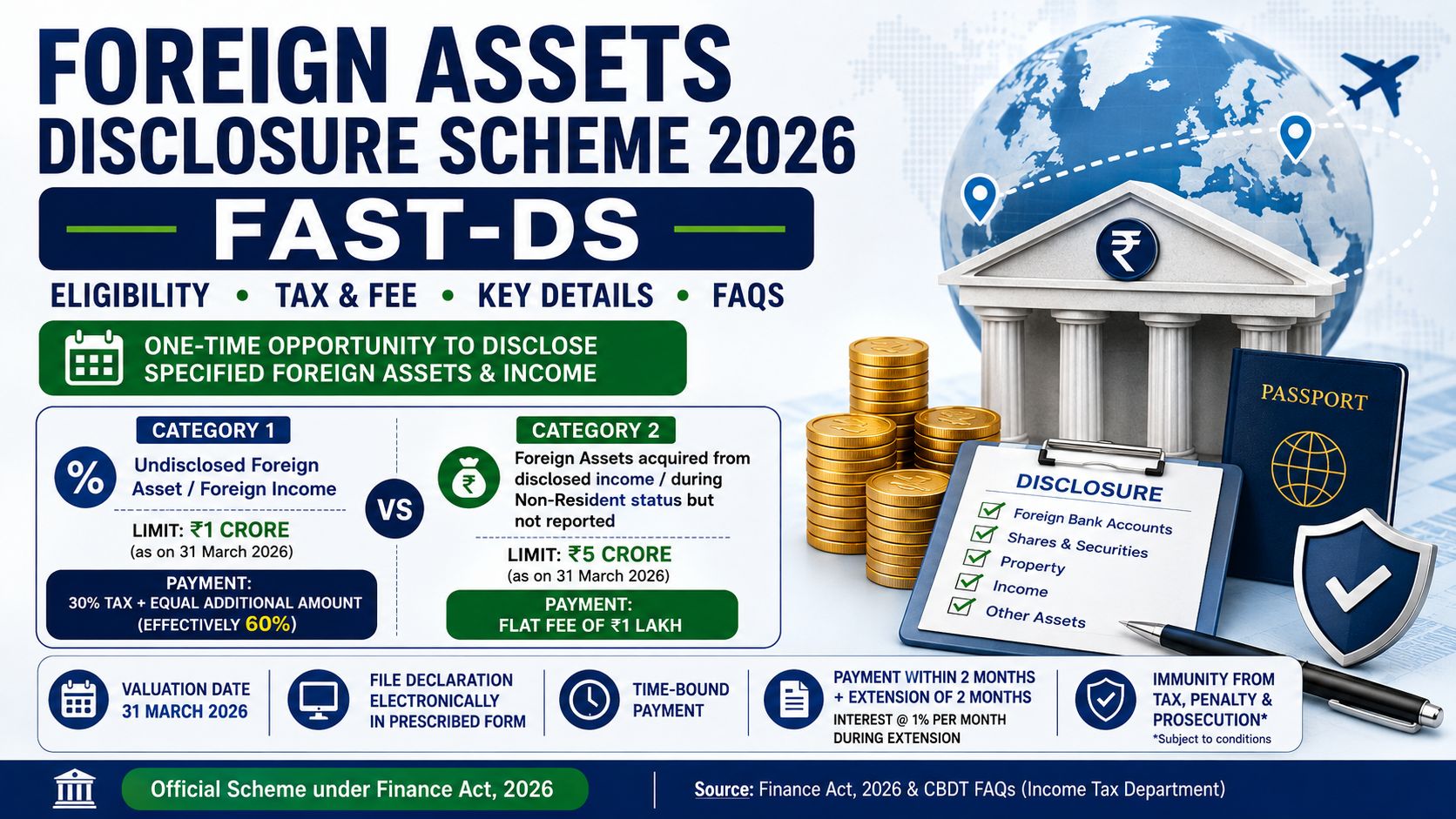
Foreign Assets Disclosure Scheme 2026 (FAST-DS): Complete Guide
The Foreign Assets of Small Taxpayers Disclosure Scheme, 2026 (FAST-DS) is a one-time scheme introduced under the Finance Act, 2026.
The Scheme provides eligible taxpayers an opportunity to disclose certain foreign income and foreign assets that were not taxed or were not reported in the return of income, subject to the conditions prescribed under the law.
For valid declarations and compliance with the Scheme, specified immunity from further tax, penalty and prosecution under the Black Money (Undisclosed Foreign Income and Assets) and Imposition of Tax Act, 2015 is provided.
Who Can Benefit From FAST-DS 2026?
The Scheme may be relevant to a person who is or was resident in India during the relevant period, subject to the conditions of the Scheme.
It can also cover a person who is currently Non-Resident (NR) or Resident but Not Ordinarily Resident (RNOR) where the person was resident in India during the relevant period connected with the foreign income or acquisition of the foreign asset.
CBDT has specifically mentioned examples such as:
- Employees receiving foreign ESOPs or RSUs
- Former students having dormant or low-balance foreign bank accounts
- Returning NRIs having foreign savings or insurance policies
- Employees deputed or working abroad
as situations where taxpayers may need to examine the Scheme.
What Foreign Assets or Income Can Be Covered?
FAST-DS covers three broad categories:
- Undisclosed foreign income
- Undisclosed assets located outside India
- Certain foreign assets acquired from foreign income while the taxpayer was non-resident or from income already offered to tax in India, but not reported in the relevant return schedule.
Foreign assets may include, depending on the facts:
- Foreign bank accounts
- Foreign shares and securities
- Foreign financial interests
- Foreign property
- Foreign insurance or other financial assets
- ESOPs / RSUs
The exact treatment depends on the nature, source and reporting history of the asset.
₹1 Crore vs ₹5 Crore Limit
This is one of the most important points about FAST-DS 2026.
The ₹1 crore and ₹5 crore limits apply to different categories.
Category 1 – Undisclosed Foreign Asset / Foreign Income
For undisclosed foreign assets or undisclosed foreign income, the aggregate value must not exceed ₹1 crore as on 31 March 2026.
Category 2 – Foreign Asset Acquired From Disclosed Income / During Non-Resident Status
For specified foreign assets acquired from income already offered to tax in India or acquired during non-resident status but not reported, the asset value must not exceed ₹5 crore as on 31 March 2026.
Therefore, ₹5 crore is not the general FAST-DS limit.
How Much Tax or Fee Is Payable?
Category 1
For undisclosed foreign assets or undisclosed foreign income:
30% tax + additional amount equal to 100% of the tax
Therefore, the total amount payable is effectively:
60% of the relevant value
This treatment is expressly stated in the CBDT FAQ.
Example
If the relevant undisclosed foreign asset/income is ₹50 lakh:
- 30% tax = ₹15 lakh
- Additional amount = ₹15 lakh
- Total = ₹30 lakh
Subject, of course, to the Scheme's eligibility conditions.
Flat ₹1 Lakh Fee for Certain Foreign Assets
Where a specified foreign asset was:
- acquired during non-resident status, or
- acquired from income already offered to tax in India,
but was not reported in the relevant return schedule, a flat fee of ₹1 lakh is payable, subject to the prescribed ₹5 crore threshold and other conditions.
Interestingly, CBDT also clarifies that if the same asset was not disclosed for multiple years, the ₹1 lakh fee is generally applicable only once for that asset, in relation to the first year of non-disclosure. Separate assets acquired in different years can have corresponding fee implications.
Valuation Date
The monetary limits under the Scheme refer to the value as on:
31 March 2026
The value of an asset is to be determined according to the valuation rules prescribed under the Scheme.
How Is the Declaration Filed?
The declaration is to be made:
- electronically;
- in the prescribed form; and
- verified in the prescribed manner.
The declaration can be made only during the period notified by the Central Government.
What Happens After Filing?
After electronic verification of eligibility and the declaration, the prescribed Income-tax authority communicates the amount payable through an order.
CBDT states that the order is to be communicated within one month from the end of the month in which the declaration is furnished.
The taxpayer then has two months from the end of the month in which the order is received to make payment.
A further extension of two months is permitted.
Interest for Extended Payment Period
If payment is made during the extended period, simple interest at 1% for every month or part of a month is payable on the unpaid amount.
Immunity Under FAST-DS
A taxpayer who makes a valid declaration and pays the prescribed amount can receive immunity from further tax, penalty and prosecution under the Black Money Act in respect of the income or asset covered by the declaration, subject to the Scheme's conditions.
This immunity is not a blanket immunity for every tax matter of the taxpayer.
It relates to the income or asset validly covered by the declaration.
When Does FAST-DS Not Apply?
The CBDT FAQ specifically states that the Scheme does not apply to:
- income or assets representing proceeds of crime under the Prevention of Money Laundering Act, 2002; and
- cases where assessment proceedings under the Black Money Act have already been completed.
Therefore, eligibility must be checked carefully before filing.
Foreign Assets and Schedule FA
Foreign asset disclosure in the regular income-tax return should not be ignored.
The Income Tax Department provides specific guidance for Schedule FA, including reporting of foreign assets and foreign income.
Taxpayers having foreign assets should therefore review:
Previous ITRs → Schedule FA → Foreign income → Source of funds → AIS information.
Check Foreign Asset Information in AIS
The Income Tax Department has also enabled taxpayers to view certain Foreign Asset Information received through CRS/FATCA in AIS. The facility was announced by CBDT in July 2026.
However, AIS should not be treated as a substitute for the taxpayer's own records.
A taxpayer should independently verify all foreign assets and foreign income.
Simple Example
Example 1 – Undisclosed Foreign Asset
A resident taxpayer owns an unexplained foreign investment worth ₹40 lakh.
If the asset falls within Category 1 and all conditions are satisfied:
₹40 lakh × 60% = ₹24 lakh
Potential amount payable under the Scheme:
₹24 lakh
Example 2 – Foreign Shares Bought From Taxed Income
A taxpayer earned income in India, paid applicable tax and used ₹30 lakh of the disclosed funds to purchase foreign shares.
The shares were not reported in the relevant Schedule.
If the taxpayer satisfies the Category 2 conditions and the asset value is within the ₹5 crore threshold:
Applicable fee = ₹1 lakh
The exact treatment should be confirmed based on the facts and applicable rules.
FAST-DS 2026 – Quick Summary
| Particular | Details |
|---|---|
| Scheme | FAST-DS 2026 |
| Full Name | Foreign Assets of Small Taxpayers Disclosure Scheme, 2026 |
| Category 1 Limit | ₹1 crore |
| Category 2 Limit | ₹5 crore |
| Category 1 Payment | 30% tax + equal additional amount |
| Effective Category 1 Amount | 60% |
| Category 2 Fee | ₹1 lakh |
| Valuation Reference | 31 March 2026 |
| Filing | Electronic |
| Extension for Payment | Further 2 months |
| Interest During Extension | 1% per month or part |
| Immunity | Subject to statutory conditions |
| Proceeds of Crime | Not eligible |
| Completed Black Money Act Assessment | Not eligible |
Frequently Asked Questions – FAST-DS 2026
1. What is FAST-DS 2026?
FAST-DS 2026 is the Foreign Assets of Small Taxpayers Disclosure Scheme, 2026, providing a one-time opportunity to eligible taxpayers to disclose specified foreign assets and foreign income subject to payment of the prescribed tax or fee.
2. Who can use FAST-DS?
Persons who are or were resident in India during the relevant period and satisfy the conditions of the Scheme may be eligible. Certain persons currently NR or RNOR may also qualify based on their historical residential status.
3. Is FAST-DS applicable to foreign bank accounts?
Potentially yes, depending on the circumstances, source of funds, reporting history and other conditions of the Scheme.
4. Can foreign shares or securities be disclosed?
Yes, specified foreign assets can fall within the Scheme, subject to the applicable category and conditions.
5. Are ESOPs and RSUs covered?
CBDT specifically identifies foreign ESOPs and RSUs as examples of foreign assets that may require review under FAST-DS.
6. What is the ₹1 crore limit?
For undisclosed foreign assets or undisclosed foreign income, the aggregate value must not exceed ₹1 crore as on 31 March 2026.
7. What is the ₹5 crore limit?
The ₹5 crore limit applies to specified foreign assets acquired from disclosed income or during non-resident status but not reported, subject to the Scheme's conditions.
8. Is the tax under FAST-DS 60%?
For the Category 1 undisclosed foreign asset/foreign income category, the total amount payable is 30% tax plus an additional amount equal to the tax, effectively 60%.
9. Is the ₹1 lakh fee applicable to every foreign asset?
No. The ₹1 lakh fee applies to the specified Category 2 foreign assets covered by the Scheme, subject to the prescribed conditions and threshold.
10. If the same foreign asset was not reported for several years, is ₹1 lakh payable every year?
CBDT states that for the same asset, the ₹1 lakh fee is applicable only once, for the first year of non-disclosure.
11. What is the valuation date?
The relevant valuation reference date is 31 March 2026, with valuation determined according to the prescribed rules.
12. Is filing under FAST-DS online?
Yes. The declaration is to be made electronically in the prescribed form and verified in the prescribed manner.
13. How long do I have to pay after receiving the order?
Payment is required within two months from the end of the month in which the order is received. A further extension of two months is permitted.
14. Is interest payable if I use the extended period?
Yes. Simple interest at 1% per month or part of a month is payable on the unpaid amount during the extended period.
15. Does FAST-DS provide immunity from prosecution?
Yes, a valid declaration followed by payment of the prescribed amount can provide immunity from further tax, penalty and prosecution under the Black Money Act in respect of the declared income or asset, subject to the statutory conditions.
16. Can proceeds of crime be declared?
No. The Scheme does not apply to income or assets representing proceeds of crime under the Prevention of Money Laundering Act, 2002.
17. Can I use FAST-DS if my Black Money Act assessment is already completed?
The CBDT FAQ states that the Scheme does not apply where assessment proceedings under the Black Money Act have already been completed.
18. Can I declare more than one foreign asset?
Yes. A single declaration may include multiple foreign income or foreign asset items, subject to the applicable monetary limits and other conditions.
19. What happens if the declaration contains false information?
If a declaration is found to be false or contains material misrepresentation or suppression of facts, the declaration can become void and applicable law may apply as if no declaration had been made.
20. Should I check AIS before making a declaration?
Yes. It is advisable to review the foreign asset information available in AIS along with your own bank, broker, property and investment records. The Income Tax Department has introduced Foreign Asset Information in AIS based on CRS/FATCA information.
What Should You Do If You Have an Undisclosed Foreign Asset?
If you have any of the following:
Foreign Bank Account | Foreign Shares | ESOP/RSU | Foreign Property | Foreign Insurance | Foreign Investment | Foreign Income
review:
1. Residential Status
2. Date of Acquisition
3. Source of Funds
4. Tax Paid on Source Income
5. Previous ITR & Schedule FA
6. AIS / CRS / FATCA Information
7. Value as on 31 March 2026
8. Applicable FAST-DS Category
Do not simply assume that every omitted foreign asset is subject to the 60% payment.
The source of funds and nature of non-disclosure are critical.
Conclusion
FAST-DS 2026 provides eligible taxpayers with a one-time opportunity to address specified foreign asset and foreign income disclosure issues.
The most important point to remember is:
₹1 Crore ≠ ₹5 Crore
The ₹1 crore limit relates to undisclosed foreign assets or undisclosed foreign income, while the ₹5 crore limit relates to the specified category of foreign assets acquired from disclosed income or during non-resident status but not reported.
If you have any foreign asset or foreign income that was not properly reported earlier, it is important to review your position carefully before making a declaration.
Source: Finance Act, 2026 and CBDT / Income Tax Department official FAQs and guidance.
Have Questions? We're Here to Help
Get expert advice from NARESH POKALA & COMPANY. Reach out to discuss your requirements.