
Why Is Gold Falling Even During War? The Real Reason Behind Gold Price Movements
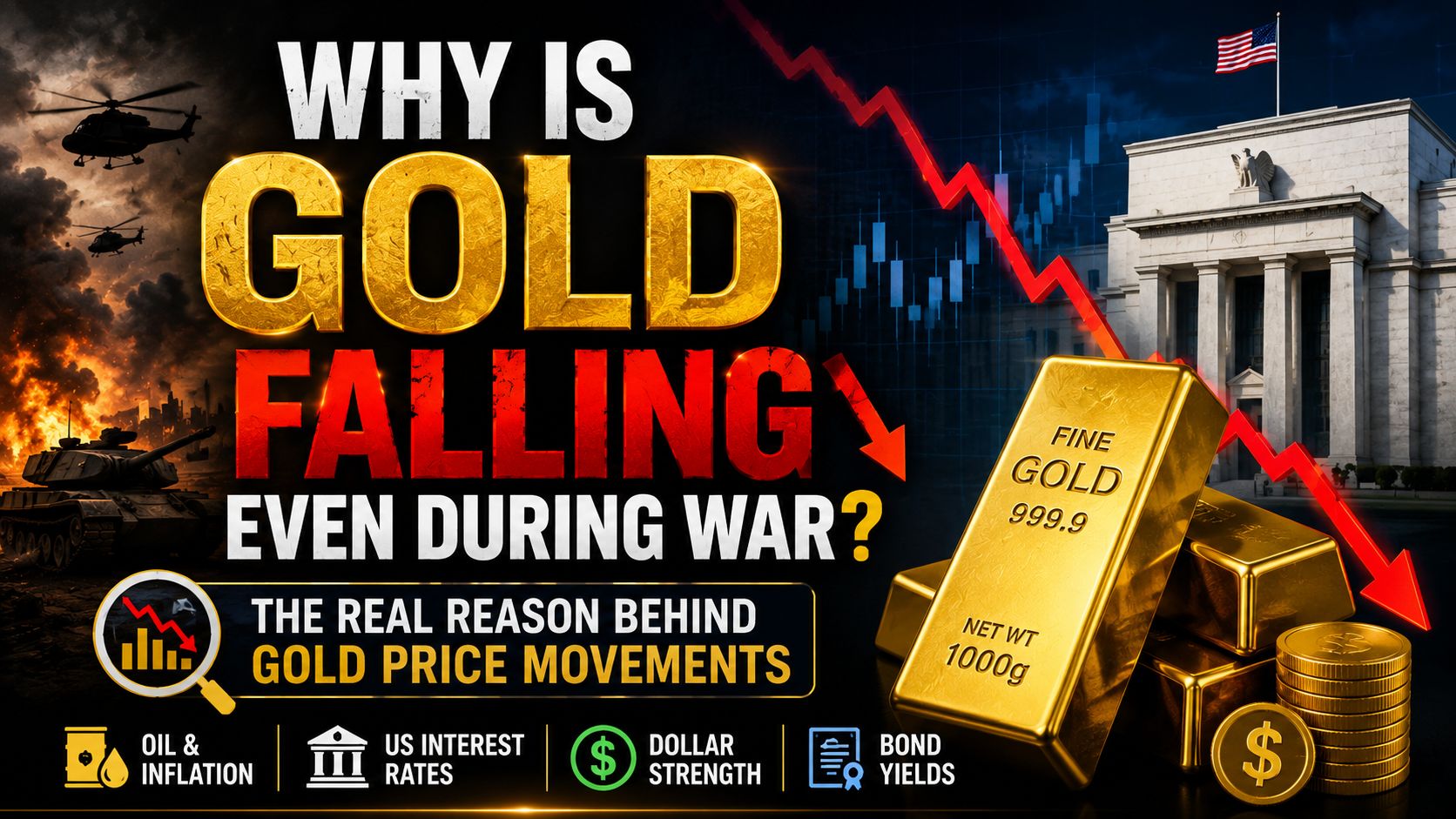
Gold Prices Are Falling Despite Global Tensions – Why?
For decades, investors have believed one simple rule:
War = Fear = Gold Prices Rise
While this rule often holds true, financial markets are rarely that simple. Gold does not react only to wars or geopolitical tensions—it reacts to global money flows, interest rates, inflation expectations, and the strength of the US Dollar.
This is why gold can sometimes decline even when the world appears uncertain.
In this article, we'll understand the real economics behind gold prices and what investors should watch before buying gold.
Why Gold Usually Rises During War
Gold is considered a safe-haven asset.
Whenever uncertainty increases due to:
- Wars
- Economic crises
- Banking failures
- Political instability
- Financial market crashes
Investors often move their money from risky assets like stocks into gold.
Historically, this demand pushes gold prices upward.
However...
Markets Don't Work on One Rule
Markets operate through a chain of events rather than a single event.
For example:
| Event | Possible Impact |
|---|---|
| War begins | Oil prices rise |
| Oil prices rise | Inflation concerns increase |
| Inflation increases | Central banks delay rate cuts |
| Interest rates remain high | US Dollar strengthens |
| Dollar strengthens | Gold faces pressure |
Therefore,
The market is not asking whether there is a war. It is asking how the war will affect inflation and interest rates.
The Biggest Enemy of Gold: High Interest Rates
Many people think gold's biggest competitor is silver.
In reality,
Gold's biggest competitor is high-yield investments.
Gold does not provide:
- Interest income
- Dividend income
- Monthly cash flow
It simply sits as a store of value.
Now imagine:
An investor has two choices:
Option 1
Buy gold
Returns depend only on future price appreciation.
Option 2
Buy government bonds paying attractive interest.
The investor earns fixed income with comparatively lower risk.
Naturally, many investors shift towards bonds.
As money moves into bonds, demand for gold weakens.
Why US Interest Rates Matter to Gold
The US Federal Reserve controls benchmark interest rates.
When rates remain high:
- Bond yields increase
- US Dollar becomes stronger
- Foreign investors buy Dollar assets
- Gold becomes relatively less attractive
Result:
Gold prices may decline.
The Chain That Many Investors Ignore
A simplified chain looks like this:
↓
Oil Prices Increase
↓
Inflation Fear
↓
Federal Reserve Keeps Rates High
↓
US Dollar Strengthens
↓
Gold Faces Pressure
Notice something important:
The war itself is not directly causing gold to fall.
The economic consequences of the war may be influencing interest rate expectations.
Gold and the US Dollar Share an Inverse Relationship
Generally,
| Strong Dollar | Weak Dollar |
|---|---|
| Gold may fall | Gold may rise |
| Imports become cheaper | Dollar weakens |
| Higher yields attract capital | Investors seek alternative assets |
Since gold is globally priced in US Dollars, a stronger Dollar often puts downward pressure on gold prices.
Gold Is Influenced by Global Money Flows
When uncertainty increases, investors can move money into:
- Cash
- US Dollar
- Government Bonds
- Gold
Many assume fear automatically sends money into gold.
But sometimes investors prefer:
- Safe cash positions
- High-yield bonds
- Dollar-denominated assets
Hence,
Fear does not always translate into higher gold prices.
History Shows This Pattern
1980
After a massive rally, high interest rates significantly pressured gold prices.
2013
Gold corrected sharply when real yields increased and investors shifted toward interest-bearing assets.
2020
Near-zero interest rates and aggressive monetary easing supported a strong rally in gold.
2022
Higher inflation led to aggressive rate hikes, strengthening the Dollar and creating pressure on gold.
Key Lesson
Gold loves uncertainty.
But gold dislikes expensive money.
Short-Term Gold Prices Are Driven by Fast Money
Gold buyers include:
Central Banks
- Buy strategically
- Long-term perspective
Families
- Buy for weddings
- Cultural reasons
- Emotional purchases
ETFs and Traders
- Buy and sell instantly
- React to news quickly
Therefore,
short-term price movements are often determined by institutional and trading flows rather than retail jewellery demand.
Should Every Fall in Gold Be Treated as a Buying Opportunity?
Not necessarily.
Before buying, ask:
Why is gold falling?
Scenario 1
Gold falls because panic reduces.
This could simply be a temporary correction.
Scenario 2
Gold falls because markets expect higher interest rates for longer.
The correction may continue.
Understanding the reason matters more than the price decline itself.
Smart Strategy for Different Buyers
| Investor Type | Suggested Approach |
|---|---|
| Jewellery buyer | Purchase based on actual need rather than speculation |
| Long-term investor | Invest gradually instead of investing all at once |
| Existing holder | Avoid panic if your investment horizon is long-term |
| Short-term trader | Track inflation, Fed policy, Dollar Index, and bond yields |
What Should Investors Watch Instead of Just War Headlines?
Keep an eye on:
- Oil prices
- US Inflation data
- Federal Reserve policy decisions
- US Dollar Index (DXY)
- US Bond Yields
- USD/INR exchange rate
These factors often influence gold prices more than headlines alone.
Final Thoughts
Gold remains one of the world's most trusted stores of value, but its price is influenced by multiple interconnected economic forces.
A simple headline like "War has started" does not automatically mean gold will rise. Investors should understand the broader macroeconomic picture—especially inflation expectations, interest rates, bond yields, and the strength of the US Dollar.
The real question is not:
"Is there a war?"
The better question is:
"How will this situation affect inflation, interest rates, and global capital flows?"
Investors who understand this relationship are better equipped to make informed decisions rather than reacting emotionally to market headlines.
Have Questions? We're Here to Help
Get expert advice from NARESH POKALA & COMPANY. Reach out to discuss your requirements.