Zero Income Tax on ₹12.75 Lakhs Salary? Here’s How the New Tax Regime Works
Article Body
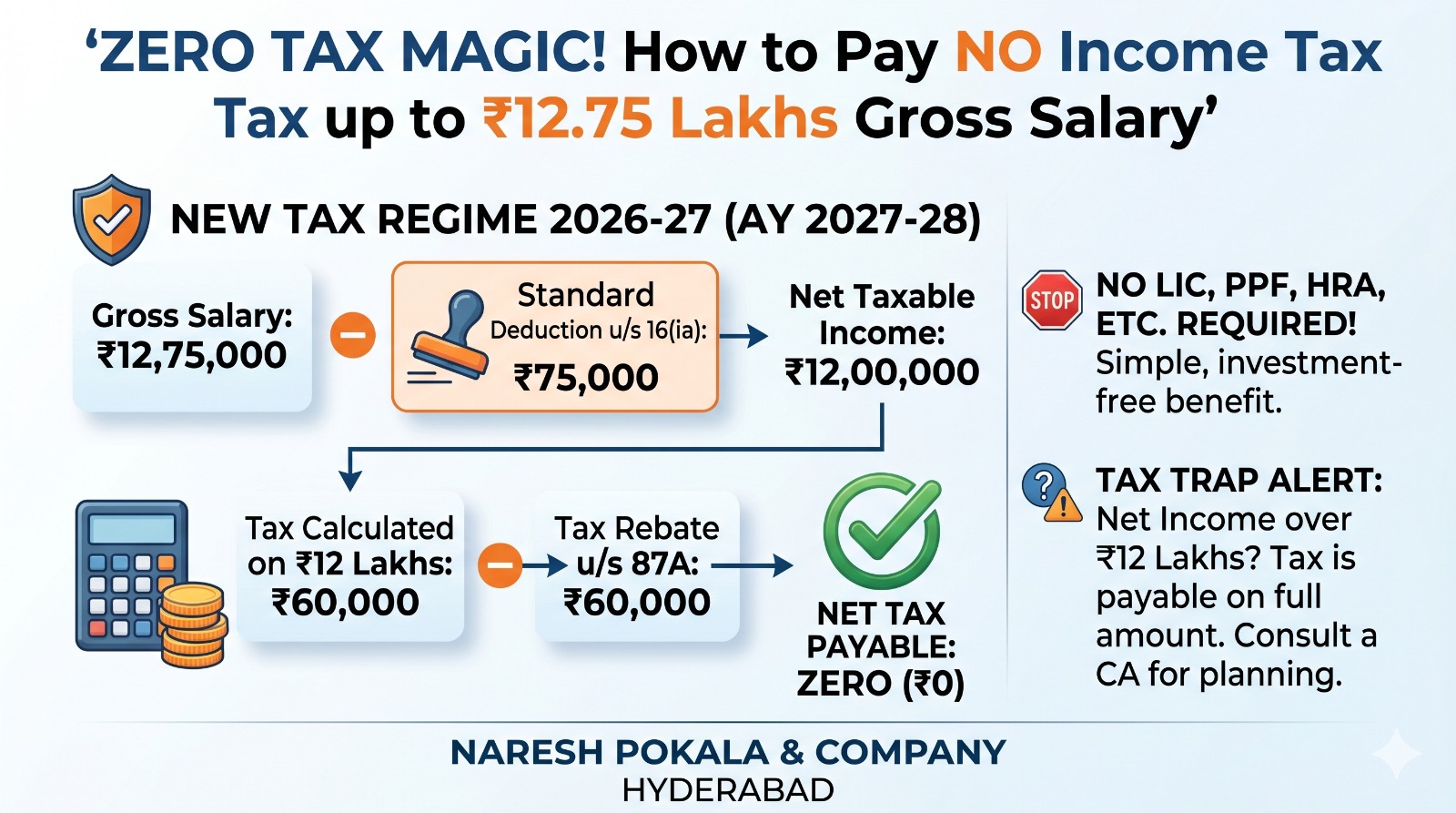
Zero Tax Magic in the New Tax Regime: No Income Tax Up to ₹12.75 Lakhs Gross Salary!
As the Income Tax Return (ITR) filing season for Assessment Year (AY) 2026-27 gains momentum, salaried taxpayers across India are increasingly shifting towards the New Tax Regime. Recent amendments introduced by the Ministry of Finance and the Central Board of Direct Taxes (CBDT) have made the regime significantly more attractive for middle-income earners.
One of the biggest highlights this year is that a salaried individual with a gross annual salary of up to ₹12.75 Lakhs may legally end up paying zero income tax under the New Tax Regime.
Let’s understand how this works in a simple and practical manner.
How is Zero Tax Possible on ₹12.75 Lakhs Salary?
This benefit becomes possible due to the combination of:
1. Standard Deduction under Section 16(ia)
Salaried taxpayers are eligible for a standard deduction of:
₹75,000
This amount is directly deducted from the gross salary.
2. Enhanced Rebate under Section 87A
Under the New Tax Regime, eligible taxpayers can claim a rebate of up to:
₹60,000
This rebate can completely eliminate the tax liability if the taxable income remains within the prescribed threshold.
Step-by-Step Tax Calculation
Gross Salary
₹12,75,000
Less: Standard Deduction u/s 16(ia)
(-) ₹75,000
Net Taxable Income
₹12,00,000
Income Tax Calculation under New Tax Regime
| Income Slab | Tax Rate | Tax Amount |
|---|---|---|
| Up to ₹4,00,000 | Nil | ₹0 |
| ₹4,00,001 – ₹8,00,000 | 5% | ₹20,000 |
| ₹8,00,001 – ₹12,00,000 | 10% | ₹40,000 |
Total Tax Before Rebate
₹60,000
Less: Rebate u/s 87A
(-) ₹60,000
Final Tax Liability
₹0 (Zero Tax)
Important Point: Do Not Cross the ₹12 Lakh Taxable Income Limit
This benefit comes with an extremely important condition.
The rebate under Section 87A is available only if the Net Taxable Income does not exceed ₹12,00,000.
Even a small excess income can remove the rebate benefit entirely.
For example:
- Bank interest
- FD interest
- Dividend income
- Capital gains
- Freelancing income
- Rental income
If these additional incomes increase your taxable income beyond ₹12,00,000, the rebate may not be available, and tax along with 4% cess may become payable.
Therefore, proper income reconciliation before filing the ITR is very important.
Why the New Tax Regime is Becoming Popular
The New Tax Regime is gaining traction because taxpayers can save tax without maintaining multiple investment proofs or claiming traditional deductions such as:
- LIC Premium
- PPF Investments
- ELSS
- HRA Exemption
- 80C Deductions
For many salaried individuals, the simplified structure and lower compliance burden make it a practical option.
However, choosing between the Old and New Tax Regime should always be based on a proper tax comparison according to individual financial situations.
Final Thoughts
The revised New Tax Regime has created a major tax-saving opportunity for salaried individuals earning up to ₹12.75 Lakhs annually. With proper planning and accurate reporting of all income sources, taxpayers may legally reduce their tax liability to zero.
Before filing your Income Tax Return, it is always advisable to review your complete income structure carefully and choose the regime that offers maximum benefit.
For professional assistance in ITR filing, tax planning, GST compliance, and business advisory services, contact Naresh Pokala & Company.
🌐 Website: www.nareshpokala.in
Have Questions? We're Here to Help
Get expert advice from NARESH POKALA & COMPANY. Reach out to discuss your requirements.