DIR-3 KYC Due Date & Penalty 2026: Latest MCA Rules Every Director Must Know
DIR-3 KYC Due Date & Penalty 2026: Latest MCA Rules Every Director Must Know
Introduction
The Director Identification Number (DIN) is a unique identification number allotted by the Ministry of Corporate Affairs (MCA) to every director under the Companies Act, 2013. To ensure that the records maintained by the MCA remain accurate and updated, directors are required to complete DIR-3 KYC compliance.
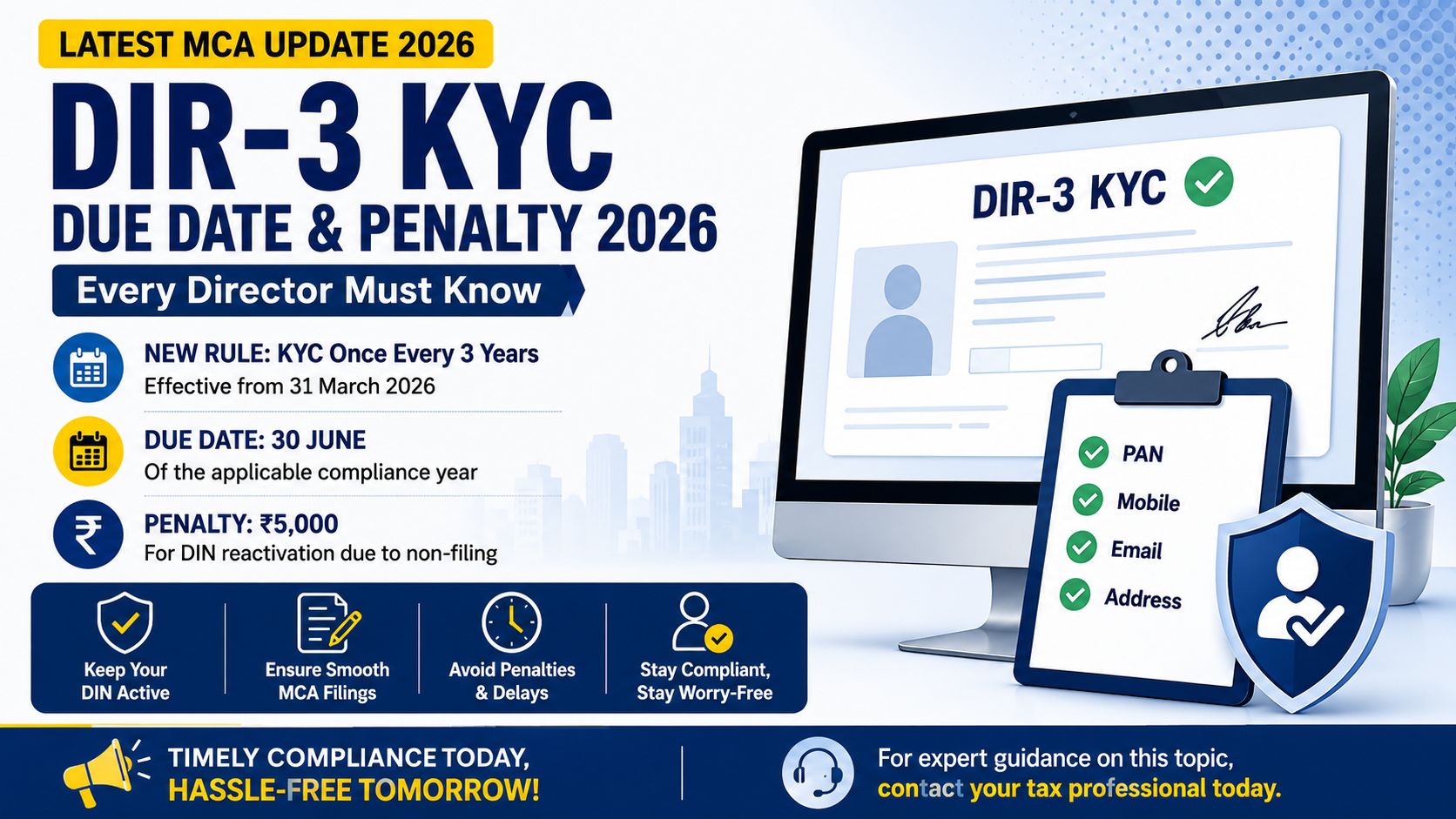
In a major compliance relief, the MCA has amended the Companies (Appointment and Qualification of Directors) Rules, 2014 through the Companies (Appointment and Qualification of Directors) Amendment Rules, 2025 (G.S.R. 943(E) dated 31 December 2025). Effective 31 March 2026, the annual DIR-3 KYC requirement has been replaced with a once-every-three-consecutive-financial-years filing system.
This article explains the latest DIR-3 KYC rules, due dates, penalties, advantages, disadvantages, documents required, FAQs, and important compliance tips for directors.
What is DIR-3 KYC?
DIR-3 KYC is a compliance mechanism through which every eligible Director Identification Number (DIN) holder verifies and updates their personal details with the MCA.
The objective is to:
-
Maintain an authentic database of directors
-
Prevent misuse of DINs
-
Improve transparency and corporate governance
Need help with this? Talk to NARESH POKALA & COMPANY → -
Ensure communication details remain updated
The KYC generally includes:
-
PAN
-
Full Name
-
Mobile Number
-
Email Address
-
Residential Address
-
Other prescribed information
Latest MCA Update for 2026
The MCA has introduced a significant change to director compliance requirements.
Under the amended Rule 12A:
-
Annual DIR-3 KYC has been replaced by once every three consecutive financial years.
-
The applicable filing is required through DIR-3 KYC Web.
-
The due date is 30 June of the applicable compliance year.
-
Any change in mobile number, email address, or residential address should be intimated through the prescribed process within the timeline specified by the MCA.
-
The objective of the amendment is to reduce unnecessary compliance burden while ensuring updated director information.
Old System vs New System
| Aspect | Old System (Pre-31 March 2026) | New System (Effective from 31 March 2026) |
|---|---|---|
| Frequency of KYC | Every financial year | Once every three consecutive financial years |
| Applicable Form | DIR-3 KYC / DIR-3 KYC Web | DIR-3 KYC Web |
| Regular Due Date | 30 September every year | 30 June of the applicable compliance year |
| Compliance Burden | Higher | Significantly reduced |
| Purpose | Annual verification | Periodic verification with simplified compliance |
| Update of Mobile/Email/Address | Through applicable KYC filing | Changes to be updated through DIR-3 KYC Web as prescribed |
| Penalty for Non-Compliance | DIN could be deactivated and prescribed fee payable for reactivation | DIN may be marked "Deactivated due to Non-filing of DIR-3 KYC" and reactivation generally requires payment of the prescribed ₹5,000 fee |
| Effect on DIN | DIN may become inactive | DIN may become inactive if compliance is not completed |
| Government Objective | Maintain updated records | Ease of Doing Business and reduced compliance burden |
DIR-3 KYC Due Date 2026
Under the amended framework:
-
DIR-3 KYC is generally required once every three consecutive financial years.
-
The applicable compliance should be completed on or before 30 June of the relevant compliance year.
Directors should verify their applicability and avoid waiting until the last date to prevent technical issues or filing delays.
Who Should Complete DIR-3 KYC?
The compliance generally applies to individuals holding a Director Identification Number (DIN) under the Companies Act, 2013.
This includes:
-
Directors of Private Limited Companies
-
Directors of Public Companies
-
Directors of One Person Companies (OPCs)
-
DIN holders required to maintain active status
-
Other applicable DIN holders as prescribed by MCA
Documents Required
Before initiating DIR-3 KYC, keep the following documents ready:
-
PAN Card
-
Aadhaar Card (where applicable)
-
Passport (for foreign nationals, if applicable)
-
Active Mobile Number
-
Active Email Address
-
Residential Address Proof
-
Digital Signature Certificate (where required)
Having these documents ready helps complete the filing smoothly.
Advantages of Completing DIR-3 KYC on Time
Timely compliance offers numerous benefits:
✅ Keeps Your DIN Active
An active DIN enables directors to sign MCA forms and continue statutory compliances without interruption.
✅ Avoids Additional Costs
Timely filing prevents the need for DIN reactivation and associated fees.
✅ Smooth ROC Compliance
Company filings can proceed without delays caused by director-related compliance issues.
✅ Maintains Updated Records
Correct contact details ensure seamless communication with regulatory authorities.
✅ Better Corporate Governance
Compliance enhances credibility before regulators, banks, investors, and stakeholders.
✅ Saves Time
Completing KYC before the deadline avoids last-minute portal congestion and technical problems.
Disadvantages of Not Completing DIR-3 KYC
Failure to comply may result in:
-
❌ DIN being marked as "Deactivated due to Non-filing of DIR-3 KYC."
-
❌ Inability to sign MCA forms.
-
❌ Delay in ROC filings.
-
❌ Additional compliance costs.
-
❌ Delay in corporate transactions requiring director authentication.
-
❌ Time-consuming DIN reactivation procedures.
Penalty for Non-Compliance
Where a DIN is deactivated due to non-filing of DIR-3 KYC, reactivation generally requires filing the prescribed KYC along with the prescribed fee of ₹5,000 under the MCA framework.
Timely compliance is therefore advisable to avoid unnecessary costs and delays.
What If Your Mobile Number or Email Changes?
If there is any change in:
-
Mobile Number
-
Email Address
-
Residential Address
the amended rules require updating the information through the prescribed DIR-3 KYC Web process within the applicable timeline.
Keeping your information updated helps ensure uninterrupted compliance.
Common Mistakes to Avoid
Many directors face delays because of simple mistakes such as:
-
Incorrect PAN details
-
Inactive mobile number
-
Wrong email address
-
Mismatch between MCA records and supporting documents
-
Waiting until the last date
-
Using outdated address proof
-
Ignoring MCA notifications
Avoiding these mistakes can save time and prevent compliance issues.
Compliance Checklist
Before filing, verify the following:
✅ PAN details are correct
✅ Mobile number is active
✅ Email address is accessible
✅ Residential address is updated
✅ Supporting documents are valid
✅ MCA profile information is accurate
Frequently Asked Questions (FAQs)
1. Is DIR-3 KYC still an annual compliance?
No. Effective from 31 March 2026, the annual filing requirement has been replaced with a once every three consecutive financial years compliance framework.
2. What is the due date?
The applicable DIR-3 KYC should generally be completed on or before 30 June of the relevant compliance year.
3. What happens if DIR-3 KYC is not completed?
The DIN may be marked as "Deactivated due to Non-filing of DIR-3 KYC," affecting MCA filings and director-related compliances until reactivation.
4. What is the penalty?
Where reactivation is required due to non-filing, the prescribed fee is generally ₹5,000 under the MCA framework.
5. Can I update my contact details later?
Yes. Changes in mobile number, email address, or residential address should be updated through the prescribed DIR-3 KYC Web process as required by the amended rules.
6. Why should I take professional assistance?
Professional assistance helps:
-
✔ Ensure accurate documentation
-
✔ Avoid filing errors
-
✔ Complete compliance on time
-
✔ Stay updated with the latest MCA amendments
-
✔ Prevent penalties and delays
Why Timely DIR-3 KYC Matters
DIR-3 KYC is more than a routine compliance requirement. It protects the validity of your DIN, facilitates smooth corporate filings, enhances governance standards, and reduces legal and operational risks.
Although the MCA has simplified the compliance framework by introducing a three-year filing cycle, directors should continue to monitor their applicable due dates and keep their information updated.
Conclusion
The MCA's latest amendment replacing annual DIR-3 KYC with a three-year compliance cycle is a welcome reform aimed at improving the Ease of Doing Business in India. However, directors should not overlook this obligation. Timely completion of DIR-3 KYC and prompt updating of personal details can help avoid DIN deactivation, additional costs, and delays in corporate compliances.
Need Professional Assistance?
If you need help with DIR-3 KYC filing, DIN reactivation, ROC compliance, company law matters, or other MCA-related services, our team can assist you with accurate and timely compliance.
For expert guidance on this topic, contact your tax professional today.
Have Questions? We're Here to Help
Get expert advice from NARESH POKALA & COMPANY. Reach out to discuss your requirements.