
Who Pays Tax on Vaibhav Suryavanshi's Income? Taxation of Minor Children Explained
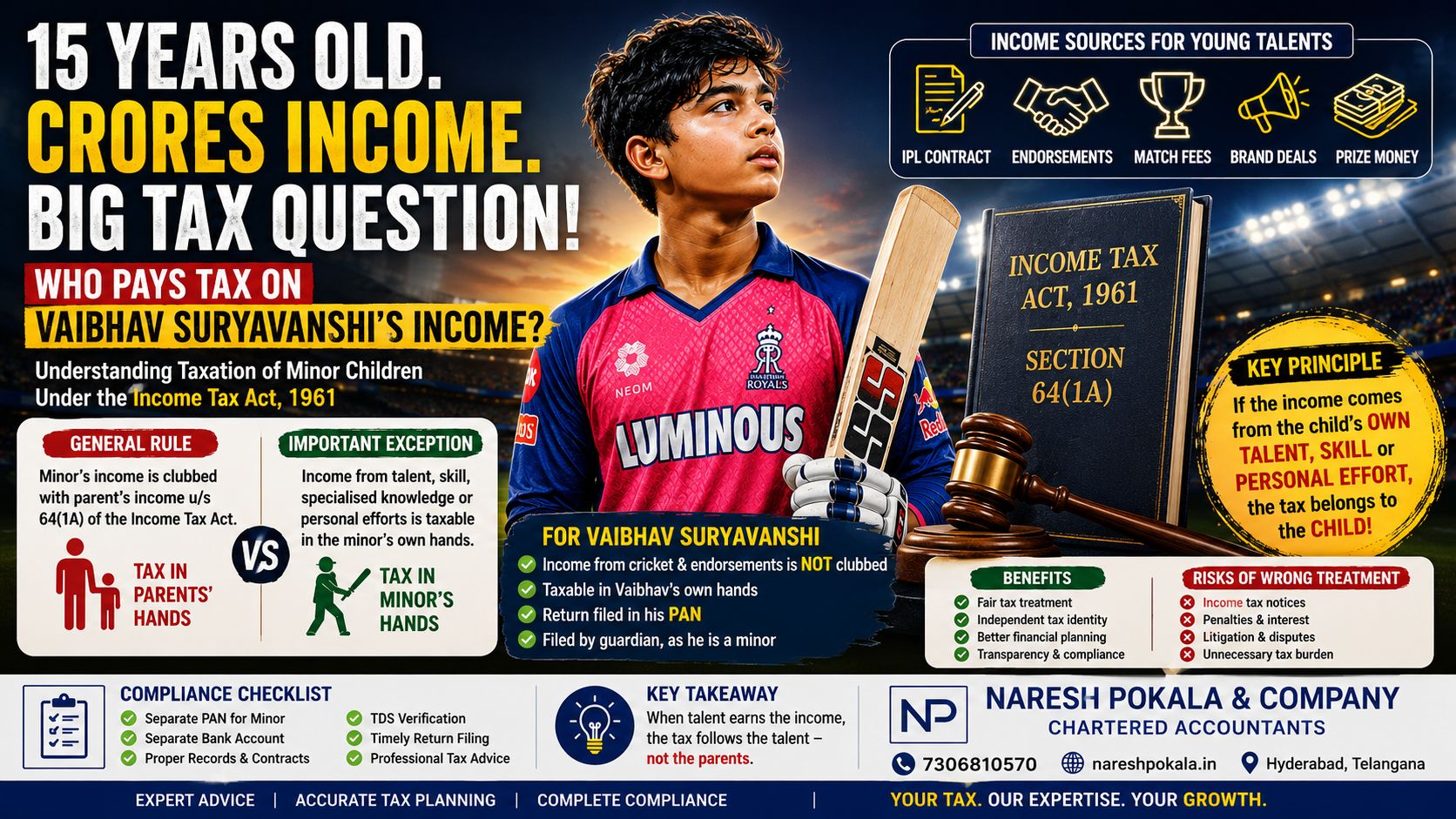
🏏 Minor Crorepati Cricketer, Major Tax Question: Who Pays Tax on Vaibhav Suryavanshi's Income?
Understanding the Taxation of Minor Children Under the Income Tax Act, 1961
At just 15 years of age, cricket sensation Vaibhav Suryavanshi has become one of India's most talked-about young sports stars. With IPL contracts, sponsorships, endorsements, match fees, and prize money potentially worth crores of rupees, a fascinating tax question arises:
If a minor earns crores, who pays the income tax—the child or the parents?
Most taxpayers believe that every rupee earned by a minor child is automatically taxed in the hands of the parents. However, the Income Tax Act contains a powerful exception that changes the answer completely.
Let's understand how the law works.
General Rule: Minor Child's Income is Clubbed with Parent's Income
Under Section 64(1A) of the Income Tax Act, 1961, the income of a minor child is generally added (clubbed) with the income of the parent whose total income is higher before such clubbing.
The purpose of this provision is to prevent tax avoidance through transfer of assets or investments to minor children.
Common Examples of Clubbed Income
The following income is generally taxable in the hands of the parent:
-
Interest on Fixed Deposits
-
Savings Bank Interest
Need help with this? Talk to NARESH POKALA & COMPANY → -
Dividend Income
-
Rental Income
-
Capital Gains from gifted investments
-
Income from assets transferred by parents
Example
Suppose a father invests ₹10 lakhs in the name of his minor child and the investment generates interest income.
The interest income will generally be clubbed with the father's income and taxed accordingly.
The Important Exception: Income Earned Through Talent, Skill or Personal Efforts
The law recognizes that some minors earn income because of their own extraordinary abilities and not because of investments made by parents.
Therefore, the clubbing provisions do not apply to income earned from:
-
Personal skill
-
Talent
-
Specialized knowledge
-
Experience
-
Manual work performed by the minor
This means the income is taxable in the hands of the minor and not in the hands of the parents.
How Does This Apply to Vaibhav Suryavanshi?
Now consider the case of young cricket star Vaibhav Suryavanshi.
If he earns income from:
-
IPL Contracts
-
Match Fees
-
BCCI Payments
-
Prize Money
-
Sponsorship Deals
-
Brand Endorsements
-
Advertising Campaigns
-
Cricket Events and Appearances
Such income arises directly because of his cricketing talent and personal performance.
Therefore:
✅ Income is taxable in Vaibhav's own hands.
✅ Income is not clubbed with the income of his father or mother.
✅ Income Tax Return is filed in Vaibhav's PAN.
✅ The return is filed by his guardian until he attains majority.
Practical Illustration
Assume Vaibhav earns the following income during a financial year:
| Particulars | Amount |
|---|---|
| IPL Contract | ₹3,00,00,000 |
| Brand Endorsements | ₹2,00,00,000 |
| Match Fees & Bonuses | ₹50,00,000 |
| Total Income | ₹5,50,00,000 |
Tax Treatment
| Particulars | Position |
|---|---|
| Taxable in Parents' Hands | ❌ No |
| Taxable in Minor's Hands | ✅ Yes |
| Separate PAN Required | ✅ Yes |
| Return Filed by Guardian | ✅ Yes |
Even though Vaibhav is a minor, the tax liability belongs to him because the income is generated through his own talent and performance.
What Happens if Vaibhav Invests His Earnings?
Suppose Vaibhav invests a portion of his cricket earnings in:
-
Fixed Deposits
-
Mutual Funds
-
Shares
-
Bonds
-
Government Securities
The source of investment is his own professional income earned through cricket.
In such situations, the subsequent income generally continues to belong to Vaibhav and remains taxable in his own hands.
This is significantly different from investments made using funds gifted by parents.
Benefits of Separate Taxation for Talented Minors
The special exception under Section 64(1A) provides several advantages.
1. Fair Tax Treatment
Income earned through hard work and talent is taxed in the hands of the person who actually earned it.
2. Independent Financial Identity
The minor can build:
-
Separate PAN history
-
Independent tax records
-
Separate financial profile
3. Better Wealth Management
Professional earnings can be managed separately for:
-
Education planning
-
Long-term investments
-
Wealth creation
-
Future financial security
4. Greater Transparency
Separate taxation improves compliance and proper reporting of endorsements, sponsorships, and professional income.
Risks of Incorrect Tax Treatment
Many families make mistakes while reporting income earned by talented children.
Common Mistakes
❌ Clubbing professional income with parent's income
❌ Not obtaining PAN for the minor
❌ Using parents' bank accounts for professional receipts
❌ Failure to maintain contracts and sponsorship agreements
❌ Incorrect disclosure of social media or endorsement income
❌ Ignoring advance tax obligations
Such mistakes can result in:
-
Income Tax notices
-
Penalties
-
Interest liabilities
-
Assessment disputes
-
Compliance complications
Tax Planning Opportunities for Young Sports Stars and Influencers
Parents and guardians should consider the following:
Maintain Separate Bank Accounts
A dedicated bank account helps establish ownership of income.
Preserve Documentation
Maintain records of:
-
Sponsorship agreements
-
Endorsement contracts
-
Match fee statements
-
Advertising agreements
-
Prize money receipts
Monitor TDS Credits
Many organizations deduct TDS before making payments. Proper reconciliation is important.
Plan Investments Carefully
Professional income can be invested strategically for long-term wealth creation and future goals.
Who Else Can Benefit from This Exception?
The same principles apply to:
Sports Professionals
-
Cricketers
-
Tennis Players
-
Badminton Players
-
Chess Players
Entertainment Industry
-
Child Actors
-
Singers
-
Dancers
-
Television Artists
Digital Creators
-
YouTubers
-
Instagram Influencers
-
Content Creators
-
Professional Gamers
Other Talented Minors
-
Authors
-
Programmers
-
Entrepreneurs
-
Competition Winners
Whenever income arises because of a minor's own skill, talent, knowledge, or efforts, separate taxation may apply.
Compliance Checklist for Parents and Guardians
If your child earns income through talent or professional activities, ensure the following:
✅ PAN Card obtained
✅ Separate bank account maintained
✅ Income records preserved
✅ Sponsorship agreements documented
✅ TDS credits verified
✅ Advance tax reviewed
✅ Income Tax Return filed on time
✅ Professional tax advice obtained
Frequently Asked Questions (FAQs)
Is every income of a minor clubbed with the parent's income?
No. Income earned through the minor's own talent, skill, specialized knowledge, or personal efforts is not clubbed.
Can a minor have a PAN card?
Yes. A minor can obtain a PAN card and file Income Tax Returns through a guardian.
Who files the return for a minor?
The parent or legal guardian files and verifies the return on behalf of the minor.
Is IPL income of a minor taxable in the parent's hands?
No. IPL income arises from personal sporting talent and is generally taxable in the hands of the minor.
Can child actors and influencers be taxed separately?
Yes. Income earned through acting, content creation, endorsements, or performances is generally taxable in the hands of the minor.
Can a minor claim deductions under the Income Tax Act?
Yes. Subject to applicable provisions, a minor's income may be eligible for deductions and exemptions similar to other taxpayers.
Why Professional Tax Advice is Important
The taxation of minors is one of the most misunderstood areas under the Income Tax Act.
Determining whether income should be:
-
Clubbed with parents, or
-
Taxed separately in the hands of the minor
requires careful examination of facts, agreements, source of income, and supporting documents.
A wrong classification may lead to additional tax liability, notices, or future litigation.
Why Choose Naresh Pokala & Company?
At Naresh Pokala & Company, we help individuals, professionals, sportspersons, influencers, content creators, startups, and high-income families navigate complex tax laws with confidence.
Our Services
✔ Income Tax Return Filing
✔ Tax Planning for Athletes and Professionals
✔ Clubbing of Income Advisory
✔ PAN and Compliance Support for Minors
✔ TDS Verification and Reconciliation
✔ Assessment and Notice Handling
✔ Wealth and Investment Tax Planning
✔ Tax Advisory for Influencers and Digital Creators
Why Clients Trust Us
-
Personalized Professional Advice
-
Strong Technical Expertise
-
Timely Compliance Support
-
Practical Tax Solutions
-
Transparent Communication
-
End-to-End Financial Compliance Services
📞 Phone: 7306810570
🌐 Website: www.nareshpokala.in
📍 Hyderabad, Telangana
Key Takeaway
Many taxpayers assume that every rupee earned by a minor is automatically taxed in the hands of the parents. However, the Income Tax Act provides a powerful exception for income generated through a minor's own talent, skill, knowledge, or hard work.
The case of Vaibhav Suryavanshi perfectly illustrates this principle.
While he may still be a minor under law, his cricketing income is treated as his own income for tax purposes. The guardian may file the return, but the tax liability belongs to the young cricketer.
As India continues to produce young achievers in sports, entertainment, technology, and digital media, understanding the taxation of minors has become more important than ever.
Final Thought
When talent earns the income, the tax follows the talent—not the parents.
Have Questions? We're Here to Help
Get expert advice from NARESH POKALA & COMPANY. Reach out to discuss your requirements.