
EPF Wage Ceiling Increased from ₹15,000 to ₹25,000: Complete Guide for Employers and Employees
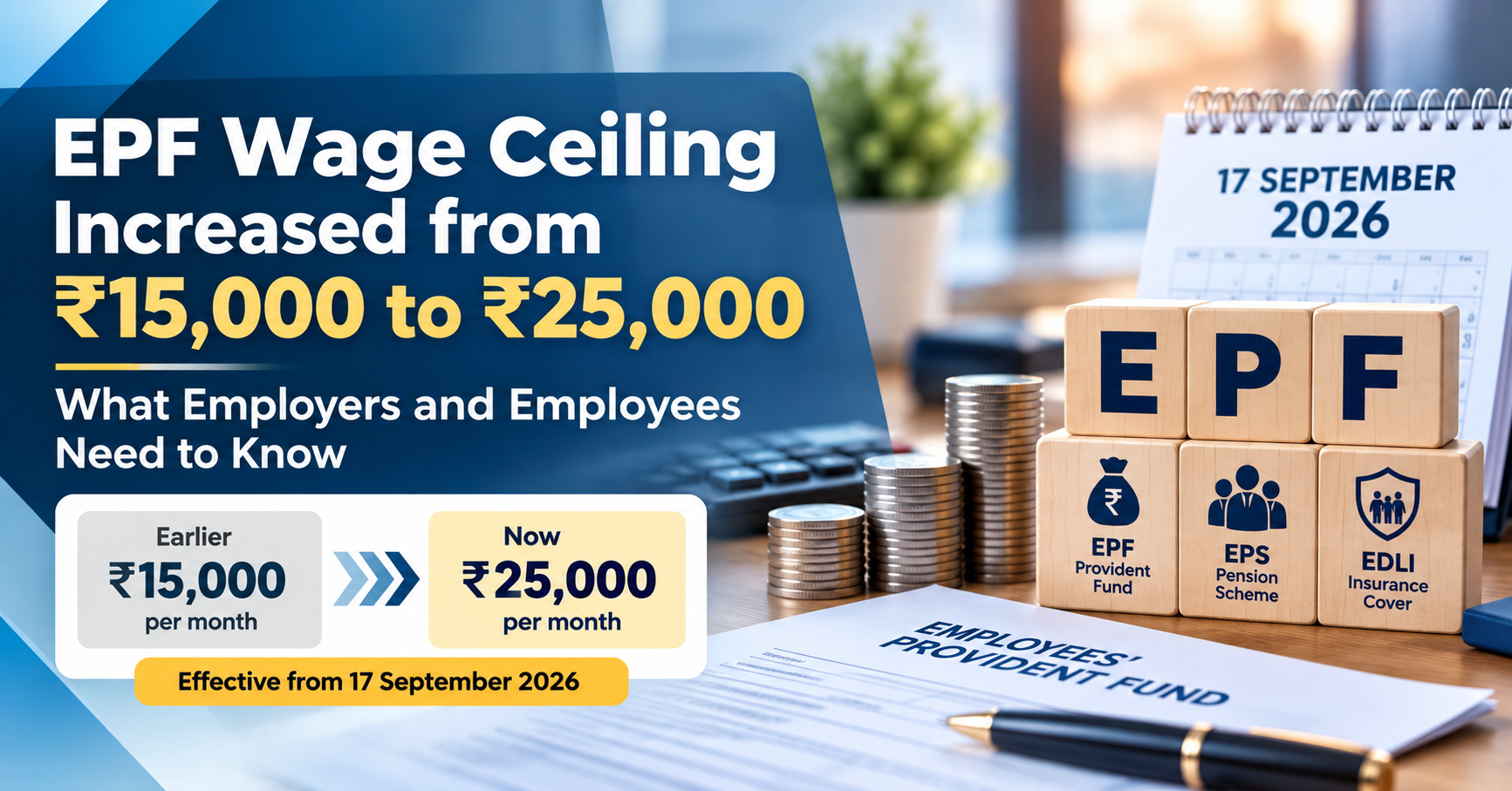
EPF Wage Ceiling Raised from ₹15,000 to ₹25,000: What Employers and Employees Need to Know
The Government has increased the EPF wage ceiling for mandatory EPFO coverage from ₹15,000 to ₹25,000 per month, with effect from 17 September 2026.
This is the first revision of the wage ceiling since September 2014 and is expected to bring more than 51 lakh additional employees within the mandatory EPFO social-security framework.
The change is important for both employees and employers because it affects EPF, EPS, EDLI, payroll calculations, employee take-home salary and monthly EPFO compliance.
EPF Wage Ceiling: What Has Changed?
The earlier statutory wage ceiling was ₹15,000 per month. It has now been increased to ₹25,000 per month.
| Particulars | Up to 16 September 2026 | From 17 September 2026 |
|---|---|---|
| EPF wage ceiling | ₹15,000 per month | ₹25,000 per month |
| Increase | — | ₹10,000 per month |
| Effective date | — | 17 September 2026 |
| Last revision | September 2014 | September 2026 |
| Employee contribution @ 12% on ceiling | ₹1,800 | ₹3,000 |
| Maximum EPS contribution @ 8.33% | Approx. ₹1,250 | Approx. ₹2,083 |
| Key affected wage range | — | ₹15,001 to ₹25,000 |
| Expected additional coverage | — | 51 lakh+ employees |
The revised ceiling was notified through S.O. 5109(E) dated 17 September 2026 under the Code on Social Security, 2020.
What Does the New EPF Wage Ceiling Mean?
In simple terms, the Government has increased the wage limit used for determining mandatory EPFO coverage from ₹15,000 to ₹25,000 per month.
Earlier, an eligible new employee earning more than ₹15,000 could, subject to the applicable provisions, fall outside mandatory EPFO coverage.
Now, eligible employees earning wages up to ₹25,000 can come within the mandatory EPFO framework.
This means employees in the ₹15,001 to ₹25,000 range are one of the major groups affected by the change.
Why Was the EPF Ceiling Increased?
The earlier ₹15,000 ceiling had remained unchanged since September 2014.
Since then:
-
Wage levels have increased.
-
Formal employment has expanded.
-
More workers are now part of the organised workforce.
-
The Government has sought to expand social-security coverage.
The Government expects the revised ceiling to bring more than 51 lakh additional employees under mandatory EPFO coverage.
Who Is Affected by the New EPF Ceiling?
The impact is not the same for every employee.
| Employee Category | Impact from 17 September 2026 |
|---|---|
| Employee with PF wages up to ₹15,000 | Already within the earlier ceiling; generally no change in ceiling |
| Employee with PF wages ₹15,001–₹25,000 who was not an EPFO member | May now come under mandatory coverage, subject to applicable conditions |
| Existing EPFO member whose contribution was capped at ₹15,000 | Contribution ceiling can increase to ₹25,000 or actual wages, whichever is lower, subject to applicable provisions |
| Existing member earning above ₹25,000 and previously capped at ₹15,000 | Statutory contribution ceiling can increase to ₹25,000 |
| Employee already contributing on higher wages voluntarily | Existing higher-wage contribution arrangement may continue, subject to applicable provisions |
| Employee earning above ₹25,000 who was never an EPFO member | The revised ₹25,000 ceiling by itself does not make the employee eligible merely because of the change; applicable coverage conditions must be examined |
EPFO has also clarified that existing members continue as members, and contributions already remitted under the earlier ceiling are not reopened merely because the ceiling has changed.
What Are the Main Benefits for Employees?
The revised EPFO coverage can provide access to three important social-security schemes:
| Scheme | Simple Explanation |
|---|---|
| EPF | Long-term provident fund savings |
| EPS | Pension-related benefits for eligible members |
| EDLI | Insurance-linked protection for eligible members |
These benefits are subject to the applicable statutory provisions and scheme conditions.
How Much PF Will Be Deducted on ₹25,000?
The employee contribution rate remains 12%.
If the applicable PF wage is ₹25,000:
₹25,000 × 12% = ₹3,000
Therefore, the employee contribution would be ₹3,000 per month in this example.
| PF Wage | Employee Contribution @ 12% |
|---|---|
| ₹15,000 | ₹1,800 |
| ₹18,000 | ₹2,160 |
| ₹20,000 | ₹2,400 |
| ₹22,000 | ₹2,640 |
| ₹25,000 | ₹3,000 |
The Government's clarification states that, for employees whose EPF and allied contributions were previously restricted to ₹15,000, the revised contribution ceiling is ₹25,000 or actual salary/wages, whichever is lower, subject to the applicable statutory provisions and scheme rules.
Important: Does Everyone Now Pay ₹3,000 PF?
No.
This is an important point for both employers and employees.
The ₹25,000 figure is the revised statutory ceiling. It does not mean every employee will automatically have a ₹3,000 PF deduction.
For example:
| Actual Applicable PF Wage | Employee PF @ 12% |
|---|---|
| ₹12,000 | ₹1,440 |
| ₹15,000 | ₹1,800 |
| ₹18,000 | ₹2,160 |
| ₹20,000 | ₹2,400 |
| ₹25,000 | ₹3,000 |
Therefore, an employee whose applicable PF wage is ₹18,000 would have an illustrative employee contribution of ₹2,160, not ₹3,000.
PF Wage Is Not Always the Same as Basic Salary
This is one of the most important areas for employers.
Under the Code on Social Security, 2020, the concept of "wages" needs to be considered rather than simply taking basic salary in isolation.
Broadly, wages include components such as:
-
Basic pay
-
Dearness allowance
-
Retaining allowance, where applicable
Certain components are excluded subject to the statutory conditions. However, where the excluded components exceed the prescribed 50% of total remuneration, the excess can be added back for determining wages.
Therefore, employers should not assume that keeping basic salary very low will automatically keep PF wages low.
Understanding the 50% Wage Rule With a Simple Example
Consider two employees.
| Particulars | Employee A | Employee B |
|---|---|---|
| Total remuneration | ₹30,000 | ₹50,000 |
| Basic + DA | ₹18,000 | ₹15,000 |
| Other excluded components | ₹12,000 | ₹35,000 |
| Excluded components as % of remuneration | 40% | 70% |
| Excess above 50% | Nil | ₹10,000 |
| PF wages | ₹18,000 | ₹25,000 |
| Employee PF @ 12% | ₹2,160 | ₹3,000 |
What happens in Employee B's case?
Total remuneration is ₹50,000.
The excluded components are ₹35,000, which is 70% of total remuneration.
The amount exceeding 50% is:
₹35,000 − ₹25,000 = ₹10,000
This ₹10,000 is added back for determining wages.
Therefore:
₹15,000 + ₹10,000 = ₹25,000
So, PF wages become ₹25,000.
The practical lesson is simple: employers should review salary structures carefully instead of calculating PF only on basic pay.
What Happens to EPS Contribution?
The revised wage ceiling also affects the pensionable wage ceiling for eligible EPS members.
The maximum EPS contribution is now calculated at 8.33% of ₹25,000, subject to the applicable provisions.
Calculation
₹25,000 × 8.33% = ₹2,082.50
That is approximately ₹2,083 per month.
| Particulars | Earlier | Revised |
|---|---|---|
| Pensionable wage ceiling | ₹15,000 | ₹25,000 |
| EPS rate | 8.33% | 8.33% |
| Maximum EPS contribution | Approx. ₹1,250 | Approx. ₹2,083 |
EPFO has confirmed the revised maximum EPS contribution of approximately ₹2,083 per month for eligible members.
Complete PF Contribution Example on ₹25,000
Suppose the applicable PF wage is ₹25,000.
The employee contributes 12%.
The employer's 12% contribution is generally allocated between EPS and EPF for EPS-eligible members.
| Component | Rate | Amount on ₹25,000 |
|---|---|---|
| Employee EPF | 12% | ₹3,000 |
| Employer EPS | 8.33% | Approx. ₹2,083 |
| Employer EPF balance | 3.67% | Approx. ₹917 |
| Total employer contribution | 12% | ₹3,000 |
| Total employee + employer contribution | 24% | ₹6,000 |
The exact treatment can vary depending on EPS eligibility and the applicable statutory provisions.
What About EDLI and Administrative Charges?
The employer's total statutory outgo is not necessarily limited to the 12% employer contribution.
Depending on the applicable provisions and rates, the employer may also have obligations relating to:
-
EDLI
-
EPF administrative charges
-
Other applicable statutory costs
Therefore, when calculating the actual cost to the business, employers should not simply assume:
Employer cost = 12%
For illustration, using the rates reflected in the source material:
| Component | Rate | On ₹15,000 | On ₹25,000 |
|---|---|---|---|
| Employee EPF | 12% | ₹1,800 | ₹3,000 |
| Employer EPS | 8.33% | Approx. ₹1,250 | Approx. ₹2,083 |
| Employer EPF | 3.67% | Approx. ₹550 | Approx. ₹917 |
| EDLI | 0.5% | ₹75 | ₹125 |
| Administrative charges | 0.5% | ₹75 | ₹125 |
| Illustrative total employer outgo | — | ₹1,950 | ₹3,250 |
The EDLI and administrative-charge figures above should be checked against the rates applicable at the time of payroll finalisation.
Advantages of Increasing the EPF Wage Ceiling
1. Wider Social-Security Coverage
More employees can now come under mandatory EPFO coverage.
This is particularly relevant to employees in the ₹15,001–₹25,000 wage range.
The Government expects more than 51 lakh additional employees to be covered.
2. Higher Retirement Savings
Employees who were previously contributing on a ₹15,000 ceiling may now have contributions calculated on a higher applicable wage.
For example:
| PF Wage | Employee PF @ 12% |
|---|---|
| ₹15,000 | ₹1,800 |
| ₹20,000 | ₹2,400 |
| ₹25,000 | ₹3,000 |
A higher contribution can help build greater retirement savings over the long term.
3. Higher Pension Contribution Ceiling
The maximum applicable EPS contribution rises from approximately ₹1,250 to approximately ₹2,083 per month.
This increases the pension contribution base for eligible members.
4. Wider Insurance Protection
Eligible employees can also receive EDLI-related insurance protection under the applicable scheme.
5. Greater Formal Social Security
The revision brings a larger number of workers within the organised social-security framework.
Disadvantages and Challenges
The change also creates certain practical challenges.
1. Higher Employee Deduction
Where an employee's PF contribution increases, the employee's immediate take-home salary may decrease.
For example:
| Particular | Earlier | Revised Illustration |
|---|---|---|
| PF wage ceiling | ₹15,000 | ₹25,000 |
| Employee PF @ 12% | ₹1,800 | ₹3,000 |
| Difference | — | ₹1,200 |
The ₹1,200 difference is not a loss; it becomes additional statutory retirement savings, subject to the applicable rules.
2. Higher Employer Cost
Employers may also face higher costs.
For example, if an employee's applicable PF wage increases from ₹15,000 to ₹25,000, the employer's statutory contribution and related charges can increase.
The exact additional cost depends on the employee's existing EPFO status and applicable contribution structure.
3. Payroll Changes
Payroll software and salary calculations may need to be updated.
Employers should check:
-
PF wage ceiling
-
Employee contribution
-
Employer contribution
-
EPS contribution
-
EDLI
-
Administrative charges
-
UAN
-
ECR
4. More Employee-Wise Verification
Businesses should not apply one formula to every employee.
Each employee's:
-
EPFO membership
-
PF wages
-
EPS eligibility
-
Previous contribution
-
Salary structure
may need to be reviewed.
Employer Cost: Simple Example
Suppose a business has 20 employees, all with applicable PF wages of ₹25,000.
Using the illustrative contribution figures:
| Particulars | Amount |
|---|---|
| PF wage per employee | ₹25,000 |
| Employee contribution | ₹3,000 |
| Employer contribution | ₹3,000 |
| Illustrative additional employer charges | ₹250 |
| Illustrative employer outgo | ₹3,250 |
| Employees | 20 |
| Monthly employer outgo | ₹65,000 |
| Annual employer outgo | ₹7,80,000 |
This is an illustration based on the rates shown above. Actual employer cost should be calculated employee-wise.
Existing Employees vs Newly Covered Employees
The financial impact is different for an existing EPFO member and a newly covered employee.
| Situation | Potential Employer Impact |
|---|---|
| Existing member already contributing on ₹15,000 | Additional cost may arise because the contribution ceiling increases |
| Existing member already contributing on actual wages | There may be little or no change |
| New employee previously outside EPFO | Employer may have the full statutory contribution cost from the applicable date |
| Employee with PF wages below ₹25,000 | Contribution is based on applicable actual PF wages, subject to the rules |
| Employee already voluntarily contributing on higher wages | Existing higher-wage arrangement needs to be reviewed |
September 2026 Is a Special Month
This is one of the most important practical points.
The revised ceiling became effective on 17 September 2026, which is in the middle of the September wage month.
Therefore, September 2026 requires special treatment.
EPFO's subsequent FAQ clarification provides for contributions for the two periods to be appropriately accounted for in the September ECR:
-
1 September to 16 September 2026: Earlier ₹15,000 ceiling
-
17 September to 30 September 2026: Revised ₹25,000 ceiling
The September contribution is reported through one ECR, with the contribution calculated appropriately for the two periods. The September ECR is ordinarily due by 15 October 2026.
September 2026: Simple Illustration
Suppose an employee has PF wages of ₹30,000 per month and contribution is restricted to the applicable ceiling.
For a 30-day month:
Period 1: 1–16 September
₹15,000 × 16 ÷ 30
= ₹8,000
Period 2: 17–30 September
₹25,000 × 14 ÷ 30
= ₹11,667 approximately
Total September PF wages
₹8,000 + ₹11,667
= ₹19,667 approximately
Employee PF at 12%
₹19,667 × 12%
= ₹2,360 approximately
| September Period | Days | Ceiling | Proportionate PF Wage |
|---|---|---|---|
| 1–16 September | 16 | ₹15,000 | ₹8,000 |
| 17–30 September | 14 | ₹25,000 | Approx. ₹11,667 |
| Total | 30 | — | Approx. ₹19,667 |
| Employee PF @ 12% | — | — | Approx. ₹2,360 |
EPFO's FAQ-based clarification confirms the two-period approach for September 2026 and a single ECR for the month.
What If September Payroll Was Already Processed?
This is an important practical issue for employers.
Where the additional employee contribution became payable from 17 September but could not be deducted in the September salary, EPFO's FAQ clarification permits the employer to defer recovery of the employee share to the next payroll cycle for take-home salary computation, subject to reporting and remitting the full September contribution within the prescribed timeline.
Therefore, employers should reconcile:
September Payroll → September ECR → EPFO Payment → October Payroll Recovery, where applicable
What Should Employers Do Now?
Employers should take the following steps.
Step 1 – Identify Affected Employees
Prepare a list of employees whose applicable PF wages may exceed ₹15,000.
Step 2 – Check EPFO Membership
Check whether each employee is already an EPFO member.
Step 3 – Review Salary Structure
Determine PF wages under the applicable definition of wages.
Do not simply use basic salary without checking the applicable wage provisions.
Step 4 – Apply the 50% Rule
Review excluded allowances and determine whether any amount needs to be added back.
Step 5 – Check EPS Eligibility
Review whether the employee is eligible for EPS and whether the employer contribution needs to be divided between EPS and EPF.
Step 6 – Update Payroll Software
Update the statutory ceiling and verify the calculations.
Step 7 – Update UAN and KYC
For newly covered employees, ensure UAN generation/linking and required KYC formalities are completed.
Step 8 – Prepare September ECR
Calculate September contributions for the two applicable periods.
Step 9 – File ECR and Pay Contributions
The September 2026 ECR is ordinarily due by 15 October 2026.
Step 10 – Reconcile
Match:
Payroll records + ECR + Challan + EPFO records
Employer Compliance Checklist
| Compliance Item | Check |
|---|---|
| Identify employees earning ₹15,000–₹25,000 | ☐ |
| Review EPFO membership | ☐ |
| Check UAN | ☐ |
| Check KYC | ☐ |
| Review PF wages | ☐ |
| Apply 50% wage rule where applicable | ☐ |
| Check EPS eligibility | ☐ |
| Update payroll software | ☐ |
| Calculate September split-month contribution | ☐ |
| File September ECR | ☐ |
| Pay contribution by due date | ☐ |
| Reconcile payroll and ECR | ☐ |
| Communicate changes to employees | ☐ |
Common Mistakes Employers Should Avoid
Mistake 1: Applying ₹25,000 PF Wage to Everyone
The new ceiling does not mean every employee automatically has PF wages of ₹25,000.
Mistake 2: Assuming PF Wage Equals Basic Salary
The applicable definition of wages must be considered.
Mistake 3: Ignoring the 50% Rule
Excluded components exceeding the prescribed threshold can affect the calculation of wages.
Mistake 4: Treating September as a Full ₹25,000 Month
September 2026 is a transition month because the new ceiling became effective on 17 September.
Mistake 5: Calculating Employer Cost as Only 12%
Additional applicable charges such as EDLI and administrative charges should also be considered.
Mistake 6: Ignoring EPS
Employees newly brought within the applicable framework may also need to be reviewed for EPS eligibility.
Mistake 7: Not Reconciling ECR
Payroll calculations and ECR data should be reconciled before final submission.
EPF vs ESIC: Do Not Confuse the Two
The EPF wage ceiling has been increased to ₹25,000.
This change does not automatically change the ESIC wage ceiling.
Therefore:
| Particular | EPF | ESIC |
|---|---|---|
| Current wage ceiling referred to in this update | ₹25,000 | ₹21,000 |
| Change covered by this notification | Yes | No |
Employers should therefore assess EPF and ESIC eligibility separately.
Advantages and Disadvantages at a Glance
| Area | Advantage | Challenge |
|---|---|---|
| Employee coverage | More employees receive social-security coverage | More employees need enrolment and compliance |
| Retirement savings | Potentially higher PF savings | Higher employee deduction |
| Pension | Higher applicable EPS contribution ceiling | EPS status needs review |
| Insurance | Wider EDLI coverage for eligible members | Additional compliance |
| Employer | Better structured social-security benefits | Higher statutory cost for affected employees |
| Payroll | More comprehensive statutory coverage | Payroll software and calculations need updating |
| HR | Better employee records | More employee-wise verification |
Frequently Asked Questions
1. What is the new EPF wage ceiling?
The EPF wage ceiling for mandatory coverage has been increased from ₹15,000 to ₹25,000 per month.
2. From when is the new ceiling applicable?
The revised ceiling is effective from 17 September 2026.
3. Who is mainly affected?
Employees whose applicable wages are between ₹15,001 and ₹25,000, particularly those who were previously outside mandatory EPFO coverage because their wages exceeded ₹15,000.
4. Will every employee now pay ₹3,000 PF?
No.
₹3,000 represents 12% of ₹25,000. Employees with lower applicable PF wages will generally contribute 12% of their applicable PF wages, subject to the applicable provisions.
5. What is the maximum EPS contribution?
For applicable EPS members, the maximum contribution at 8.33% of ₹25,000 is approximately ₹2,083 per month.
6. Will take-home salary reduce?
It may reduce where the employee's PF contribution increases.
For example, an employee moving from an illustrative ₹1,800 contribution to ₹3,000 would see a ₹1,200 increase in monthly employee contribution.
7. Will employer cost increase?
It can increase, particularly where employees were previously outside EPFO coverage or their contributions were capped at ₹15,000.
8. Is PF calculated on basic salary?
Not necessarily. The applicable definition of wages must be considered, including the relevant 50% rule.
9. What happens to existing EPFO members?
Existing members continue as members. EPFO has stated that contributions already remitted at the earlier ceiling remain unaffected.
10. What happens to September 2026 PF?
September is a special transition month because the new ceiling became effective on 17 September. The two periods need to be appropriately accounted for in the September ECR.
11. When is the September 2026 ECR due?
The September 2026 ECR is ordinarily due by 15 October 2026.
12. Do employers need to file two ECRs for September?
No. The September wage month is dealt with through one ECR, with the contribution calculated taking into account the two applicable wage-ceiling periods.
13. Does the new EPF ceiling change the ESIC ceiling?
No. The EPF revision does not itself change the ESIC wage ceiling.
14. Should employers immediately change payroll to ₹25,000?
Employers should first review employee-wise EPFO membership, applicable PF wages, EPS eligibility and the September transition requirements before changing payroll calculations.
EPF Wage Ceiling: Before vs After
| Particular | Earlier Position | Revised Position |
|---|---|---|
| Wage ceiling | ₹15,000 | ₹25,000 |
| Effective date | — | 17 September 2026 |
| Employee PF @ 12% on ceiling | ₹1,800 | ₹3,000 |
| Maximum EPS @ 8.33% | Approx. ₹1,250 | Approx. ₹2,083 |
| Major affected wage range | Above ₹15,000 | ₹15,001–₹25,000 |
| Expected additional coverage | — | 51 lakh+ employees |
| Existing EPFO members | Continue | Continue |
| September 2026 | Normal month | Special transition month |
Key Takeaways
The new EPF ceiling can be understood through these important points:
-
EPF wage ceiling increased from ₹15,000 to ₹25,000.
-
The revised ceiling is effective from 17 September 2026.
-
The previous ₹15,000 ceiling had remained unchanged since September 2014.
-
More than 51 lakh additional employees are expected to come within mandatory EPFO coverage.
-
Employees earning ₹15,001–₹25,000 are a major group affected by the revision.
-
Eligible employees can receive EPF, EPS and EDLI-related social-security benefits.
-
Employee PF at 12% of ₹25,000 is ₹3,000.
-
Maximum applicable EPS contribution at 8.33% of ₹25,000 is approximately ₹2,083.
-
PF wages should be determined carefully under the applicable definition of wages.
-
The 50% wage rule can increase PF wages where excluded components exceed the prescribed limit.
-
September 2026 is a split month because the new ceiling became effective from 17 September.
-
September contributions need to be appropriately calculated for the two periods and reported through the applicable ECR mechanism.
-
Employers should review UAN, KYC, EPFO membership and EPS eligibility.
-
Payroll software should be updated and tested.
-
Employers should reconcile payroll, ECR and EPFO payments.
-
The ₹25,000 ceiling should not be blindly applied to every employee.
Conclusion
The increase in the EPF wage ceiling from ₹15,000 to ₹25,000 per month is a significant change in India's social-security framework.
For employees, the revision can provide wider access to provident fund savings, pension and insurance-related benefits. At the same time, employees whose applicable PF contribution increases may see a reduction in their immediate take-home salary.
For employers, the change requires more than simply changing the PF ceiling in payroll software. Businesses should review the applicable definition of wages, the 50% rule, employee EPFO membership, EPS eligibility, September 2026 split-month calculations and ECR filing.
The first priority for employers should be to identify affected employees and correctly calculate their September and subsequent PF contributions.
A proper employee-wise review will help businesses avoid incorrect deductions, short remittances, payroll reconciliation issues and unnecessary compliance problems.
For expert guidance on this topic, contact your tax professional today.
Have Questions? We're Here to Help
Get expert advice from NARESH POKALA & COMPANY. Reach out to discuss your requirements.