
Foreign Shares, RSUs, ESOPs & ESPPs – Simple Income Tax Guide for Indian Employees (FY 2025-26 / AY 2026-27)
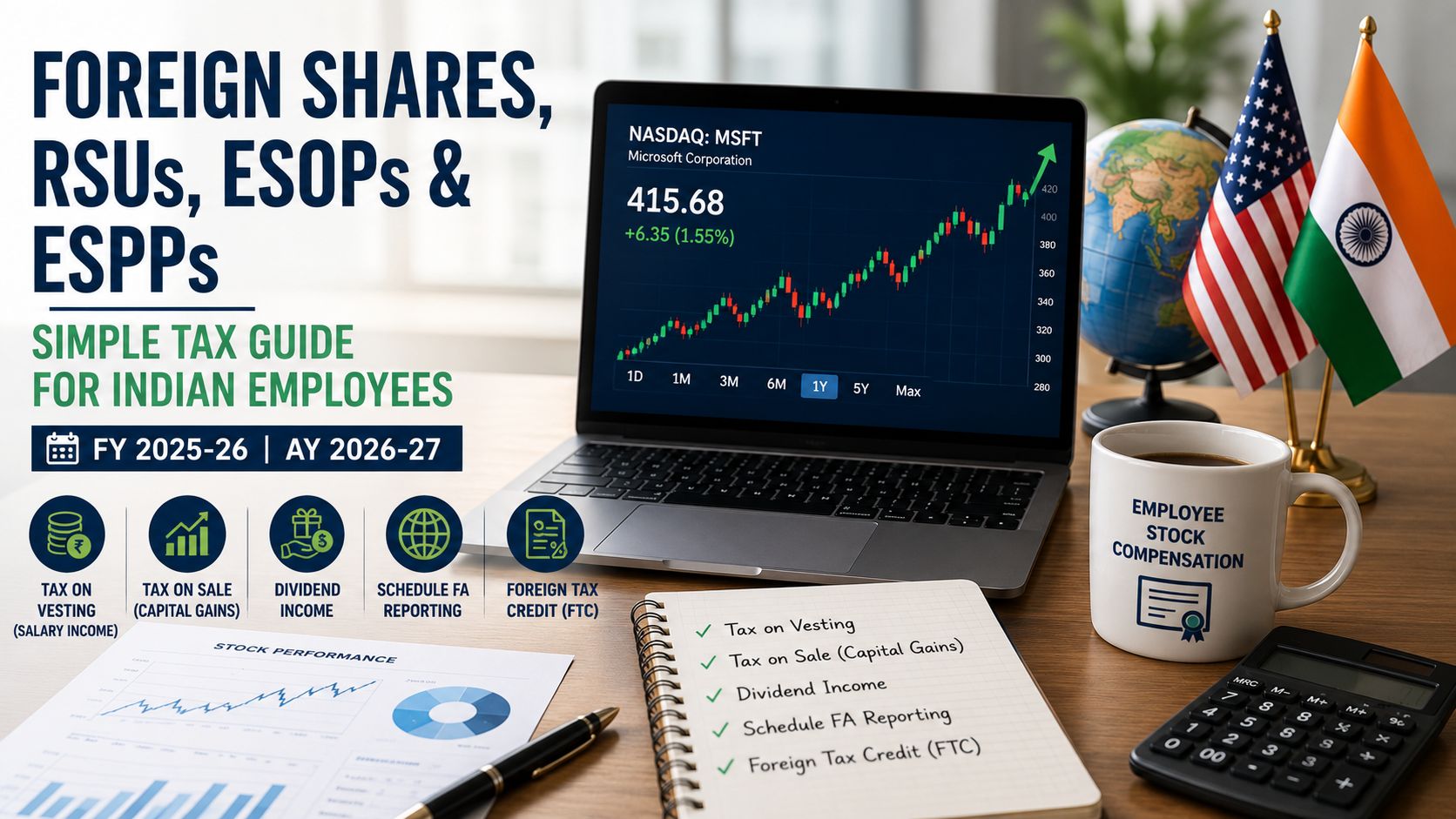
Foreign Shares, RSUs, ESOPs & ESPPs – A Simple Tax Guide for Employees in India (FY 2025-26 / AY 2026-27)
Have you received company shares from your employer?
If you work for companies like Google, Microsoft, Amazon, Apple, Meta, Adobe, Oracle, Salesforce, Nvidia, Qualcomm or any other multinational company, you may have received:
-
RSUs (Restricted Stock Units)
-
ESOPs (Employee Stock Options)
Need help with this? Talk to NARESH POKALA & COMPANY → -
ESPPs (Employee Stock Purchase Plan)
-
Foreign company shares
Many employees assume that if tax has already been deducted by their employer, there is nothing more to do. Unfortunately, that is not always correct.
Depending on your situation, you may need to:
-
Pay tax in India
-
Report your foreign shares in your Income Tax Return (ITR)
Need help with this? Talk to NARESH POKALA & COMPANY → -
Report dividend income received from foreign companies
-
Calculate capital gains when you sell the shares
-
Claim Foreign Tax Credit (FTC), if eligible
Let's understand everything in simple words.
What is an RSU?
Think of an RSU as a reward from your employer.
Instead of paying only salary, the company promises to give you shares after you continue working for a certain period.
Example
Microsoft grants you 100 RSUs.
The condition is that you must complete one year of service.
After one year, the shares become yours. This is called vesting.
What is an ESOP?
An ESOP gives you the right to buy company shares at a fixed price in the future.
If the market price increases, you can buy the shares at the lower price and benefit from the difference.
What is an ESPP?
Under an ESPP, employees can buy company shares at a discounted price, usually through monthly salary deductions.
When do you pay tax?
Many employees think tax is payable only when they sell the shares.
That is not always true.
Generally, there can be two taxable events.
1. Tax when the shares vest (Salary Income)
When your RSUs vest and the shares become yours, their value is generally treated as part of your salary.
Usually, your employer deducts TDS and includes this amount in Form 16.
Example
You receive:
-
50 RSUs
-
Market value on vesting = ₹10,000 per share
Total value = ₹5,00,000
This ₹5,00,000 is generally taxed as salary.
2. Tax when you sell the shares (Capital Gains)
Suppose you don't sell the shares immediately.
After one year, the share price increases.
Now you sell them.
The profit earned after vesting is generally taxed as Capital Gains.
Example
Value at vesting = ₹10,000 per share
Sold later for = ₹13,000 per share
Profit = ₹3,000 per share
Only this increase in value is generally considered for capital gains taxation.
What if I receive dividends?
Some foreign companies pay dividends to shareholders.
These dividends are generally taxable in India.
If tax has already been deducted in another country, you may be able to claim relief under the applicable tax treaty, subject to the prescribed conditions.
Do I need to report foreign shares in my ITR?
If you are a resident taxpayer and the reporting requirements apply to you, foreign shares may need to be disclosed in Schedule FA (Foreign Assets) of your Income Tax Return.
Not reporting foreign assets when required can create future compliance issues.
What is Foreign Tax Credit (FTC)?
Sometimes tax is deducted in another country before you receive your income.
India may also tax the same income.
To avoid double taxation, Indian tax law and tax treaties may allow you to claim Foreign Tax Credit, subject to fulfilling the applicable conditions and filing the required forms.
Common mistakes employees make
❌ Assuming Form 16 is enough.
❌ Not reporting foreign shares in the ITR when required.
❌ Forgetting to report foreign dividend income.
❌ Calculating capital gains incorrectly.
❌ Missing the requirements for claiming Foreign Tax Credit.
❌ Assuming that tax paid abroad means no tax is payable in India.
Documents you should keep safely
Keep copies of:
-
RSU or ESOP grant letter
-
Vesting statements
-
Brokerage statements
-
Share sale statements
-
Dividend statements
-
Form 16
-
Tax deduction details from the foreign country
-
Exchange rate details used for tax computation
These documents make ITR filing much easier.
Frequently Asked Questions
Is RSU income already included in Form 16?
In many cases, yes. However, you should verify your Form 16 and other records to ensure all income has been reported correctly.
I have never sold my shares. Do I still pay tax?
If your RSUs have vested, the value of the vested shares may already have been taxed as salary.
I sold my shares after two years. Do I need to report it?
Yes. The sale of shares generally needs to be reported in your Income Tax Return.
My company deducted tax in the USA. Do I still need to file in India?
Possibly yes. Depending on your residential status and other factors, you may also have tax and reporting obligations in India. You may be eligible to claim Foreign Tax Credit if the legal conditions are satisfied.
Final Thoughts
Foreign shares are a valuable employee benefit, but they also come with additional tax and reporting responsibilities.
A small mistake while filing your Income Tax Return can result in notices, delays in processing, or unnecessary tax disputes.
If you have received RSUs, ESOPs, ESPPs, foreign dividends, or have sold foreign shares during the financial year, it is advisable to review your tax position carefully before filing your ITR.
Need assistance?
Our team at Naresh Pokala & Company, Chartered Accountants helps employees of multinational companies with:
-
RSU, ESOP & ESPP taxation
-
Foreign share reporting
-
Schedule FA reporting
-
Capital gains computation
-
Foreign Tax Credit (FTC)
-
Income Tax Return filing for employees with foreign assets
For professional assistance, feel free to contact us before filing your Income Tax Return.
Have Questions? We're Here to Help
Get expert advice from NARESH POKALA & COMPANY. Reach out to discuss your requirements.