
GST Exempt Goods Under GST: Complete List, Conditions & Examples (FY 2026-27)
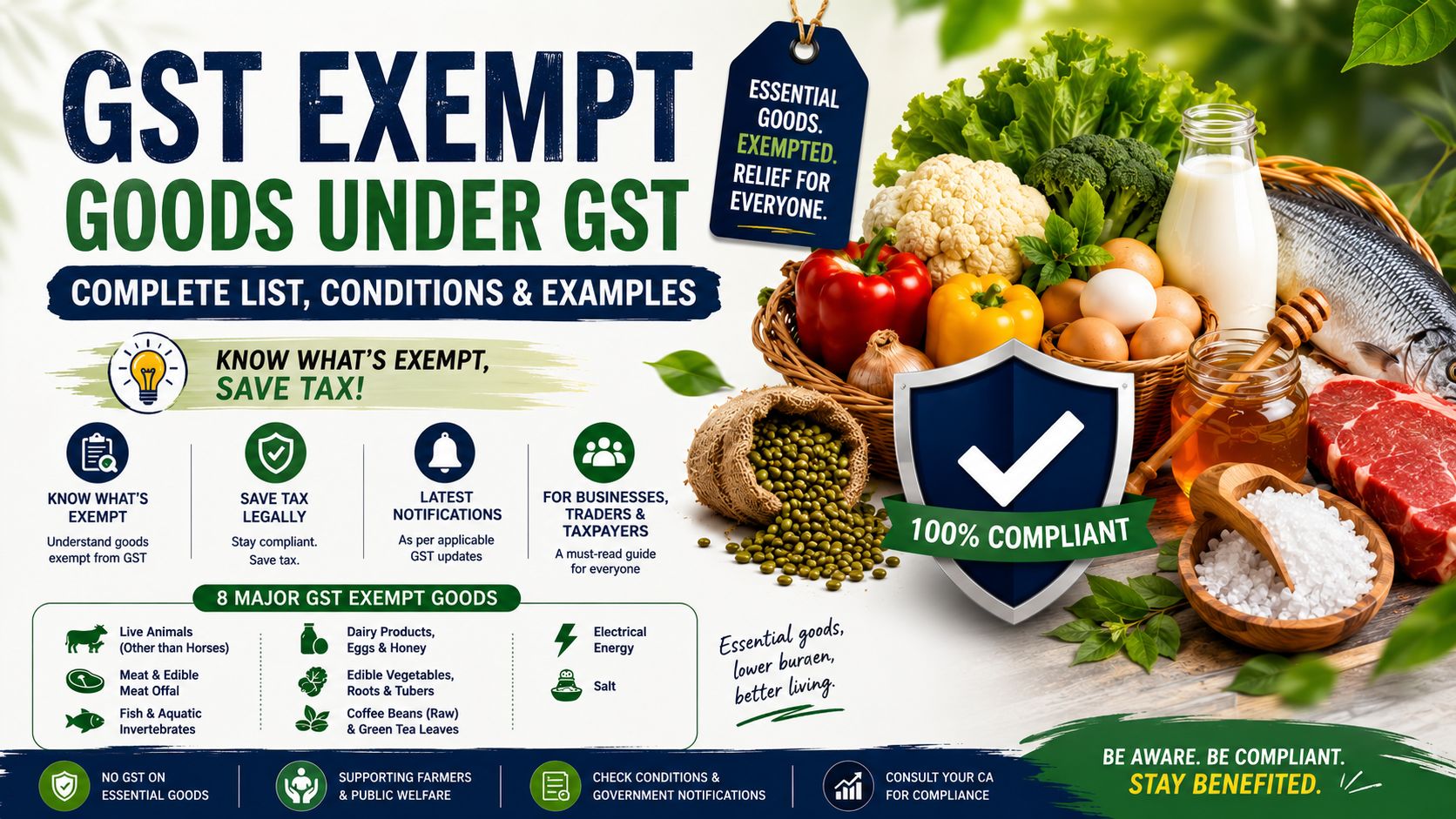
GST Exempt Goods Under GST – Complete Guide (FY 2026-27)
The Goods and Services Tax (GST) has streamlined India's indirect taxation system. However, not every product sold in India attracts GST. The Government has exempted several essential goods to reduce the tax burden on consumers and support agriculture, dairy, fisheries, and other essential sectors.
Understanding GST exemptions is important for businesses, traders, manufacturers, students, and tax professionals to ensure proper compliance and avoid unnecessary tax disputes.
What is GST Exemption?
GST exemption means that no GST is payable on the supply of specified goods notified by the Government.
For exempt goods:
- No GST is charged on the invoice.
- Suppliers generally cannot claim Input Tax Credit (ITC) on inputs used exclusively for exempt supplies.
- Buyers do not pay GST on such goods.
Why Are Certain Goods Exempt from GST?
The Government grants GST exemptions to:
- Reduce the cost of essential goods
- Support farmers and agriculture
- Control inflation
- Promote public welfare
- Ensure affordable availability of basic commodities
Common Goods Exempt Under GST
1. Live Animals (Other Than Horses)
Generally exempt:
- Cow
- Buffalo
- Goat
- Sheep
- Pig
- Poultry birds
These exemptions support India's agricultural and dairy sectors.
2. Meat and Edible Meat Offal
Fresh meat is generally exempt.
Examples include:
- Fresh chicken
- Fresh mutton
- Fresh pork
- Fresh edible meat offal
Note: Processed, frozen, branded, or packaged meat products may attract GST depending on the applicable notification.
3. Fish and Aquatic Invertebrates
Generally exempt:
- Fresh fish
- Prawns
- Crab
- Lobster
- Shrimp
Processed seafood products may be taxable.
4. Dairy Products, Bird's Eggs & Natural Honey
Generally exempt:
- Fresh milk
- Curd
- Buttermilk
- Lassi
- Fresh eggs
- Natural honey
Certain packaged or branded products may attract GST depending on applicable notifications.
5. Edible Vegetables, Roots and Tubers
Fresh vegetables are exempt from GST.
Examples:
- Potato
- Onion
- Tomato
- Carrot
- Cabbage
- Cauliflower
- Spinach
- Beetroot
6. Raw Coffee Beans & Green Tea Leaves
Agricultural produce in its natural form is exempt.
Covered:
- Raw coffee beans
- Green tea leaves
Not covered:
- Roasted coffee
- Instant coffee
- Tea powder
These processed products generally attract GST.
7. Electrical Energy
Supply of electricity is exempt from GST.
However, electrical goods like wires, switches, fans, and appliances continue to attract GST.
8. Salt
Salt remains fully exempt from GST.
Examples include:
- Common salt
- Rock salt
- Edible salt
Important Conditions
GST exemption depends on several factors:
- Nature of goods
- Processing
- Packaging
- Branding
- HSN Classification
- Government Notifications
Always verify the latest GST notification before treating any supply as exempt.
Practical Examples
Example 1: Fresh vegetables sold by a trader – GST Exempt
Example 2: Fresh milk supplied by a dairy farmer – GST Exempt
Example 3: Instant coffee sold by a manufacturer – GST Applicable
Example 4: Fresh fish supplied in the local market – GST Exempt
Example 5: Electricity supplied by a power distribution company – GST Exempt
Frequently Asked Questions
Is milk exempt from GST?
Yes. Fresh milk is generally exempt.
Is honey exempt?
Natural honey is exempt, subject to applicable conditions.
Is electricity taxable under GST?
No. Electrical energy is exempt.
Is salt taxable?
No. Salt is exempt from GST.
Are fresh vegetables taxable?
No. Fresh vegetables are generally exempt.
Can Input Tax Credit be claimed on exempt goods?
Generally, no. ITC is not available on inputs used exclusively for exempt supplies.
Conclusion
GST exemptions help keep essential goods affordable while supporting agriculture, dairy, fisheries, and public utilities. However, businesses must carefully verify HSN classification, processing level, packaging, branding, and the latest GST notifications before claiming any exemption.
Incorrect classification may result in tax demands, interest, and penalties. Professional advice can help ensure complete GST compliance.
Need Professional GST Assistance?
Naresh Pokala & Company – Chartered Accountants
We provide:
- GST Registration
- GST Return Filing
- GST Notice Reply
- GST Audit
- GST Advisory
- HSN Classification
- Input Tax Credit Consultation
- Business Compliance Services
📞 Call / WhatsApp: +91 73068 10570
🌐 Website: www.nareshpokala.in
Have Questions? We're Here to Help
Get expert advice from NARESH POKALA & COMPANY. Reach out to discuss your requirements.