GST Changes from 1 November 2026: Discounts, Faster Refunds, Scrap RCM & New Registration Rules
Several important GST amendments came into force on 1 November 2026. They change how businesses treat post-sale discounts, how quickly refunds are paid, who pays GST on scrap and waste, and how GST registration works.
What Changed on 1 November 2026?
The Central Government notified 1 November 2026 as the date from which the GST amendments made by the Finance Act, 2026 take effect. CBIC also issued a set of notifications effective from the same date. The key changes are:
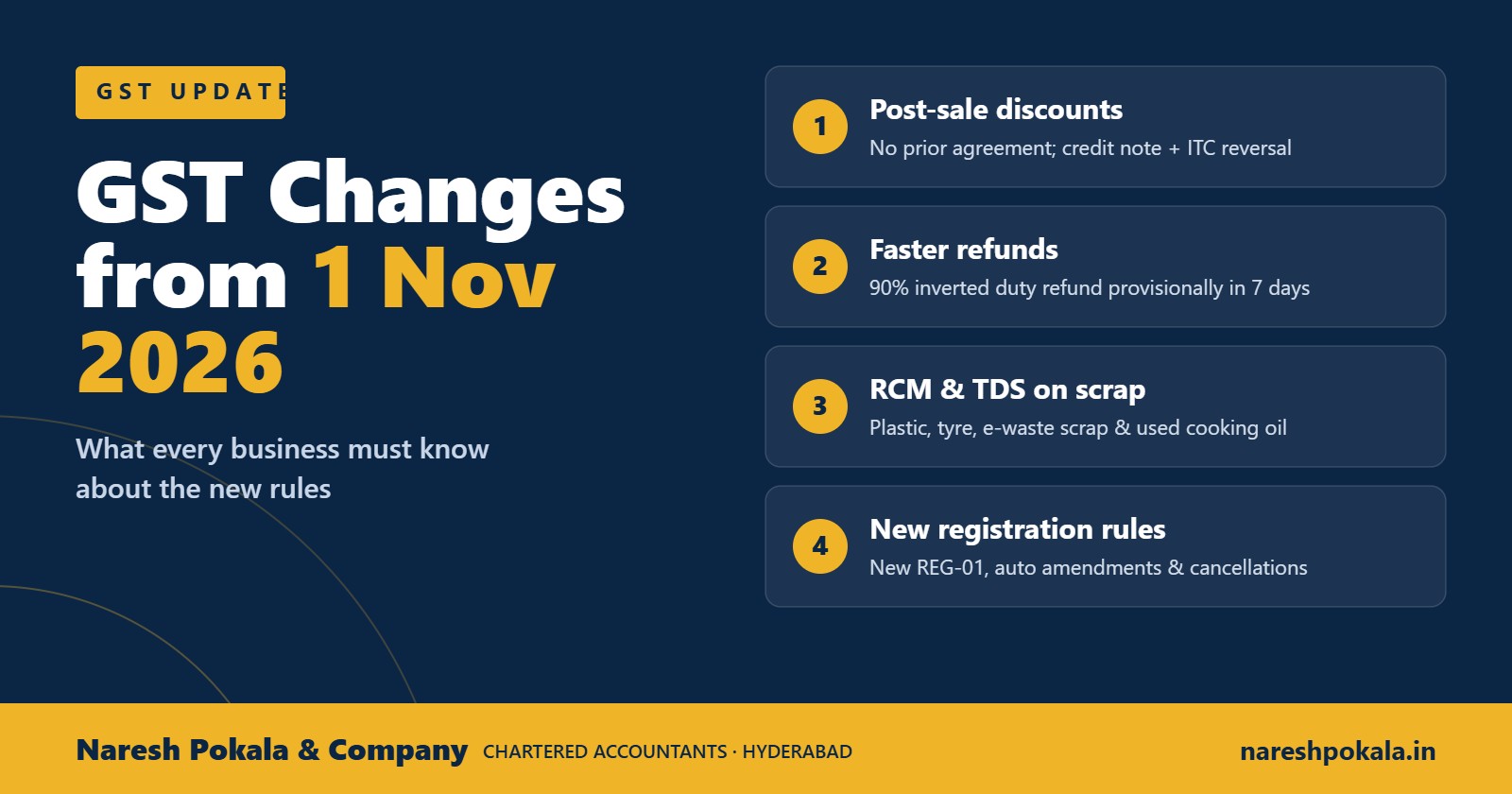
- Post-supply discounts can be excluded from taxable value without a prior agreement
- 90% of inverted duty structure refunds paid provisionally within 7 days
- Reverse charge (RCM), registration and GST TDS changes for scrap and waste
- A new GST registration process with automatic amendments and cancellations
Can Post-Sale Discounts Now Be Excluded from GST?
Yes. Earlier, a discount given after the supply could be excluded from the value of supply only if it was agreed at or before the time of supply and linked to specific invoices. The Finance Act, 2026 has removed the requirement of a prior agreement.
A post-supply discount can now be excluded from the value of supply if:
- The supplier issues a credit note for the discount, and
- The recipient reverses the input tax credit (ITC) attributable to that discount
Section 34(1) of the CGST Act, 2017 has also been amended to recognise credit notes issued for discounts covered under Section 15(3)(b).
Who benefits: distributors, dealers and supply chains that receive year-end, target-based or performance schemes that were not fixed in advance. Suppliers should keep proof that the buyer has reversed the ITC.
How Fast Will GST Refunds Be Paid?
- Inverted duty structure: 90% of an eligible refund is now granted provisionally within 7 days. This helps manufacturers whose input GST rate is higher than their output rate.
- Exports on payment of tax: the minimum threshold of ₹1,000 for sanctioning refunds on goods exported with payment of tax has been removed.
The remaining 10% of an inverted duty refund is still subject to the final order of the proper officer, so claims must be supported by correct invoices and returns.
Who Must Pay GST Under RCM on Scrap and Waste?
Under Notification No. 04/2026-Central Tax (Rate) and the matching IGST and UTGST notifications, reverse charge now applies when the following goods are supplied by an unregistered person to a registered person:
- Used cooking oil (HSN 1518)
- Plastic waste and scrap (HSN 3915)
- Tyre waste and scrap (HSN 4004)
- Electrical and electronic waste and scrap (HSN 8549)
Two related changes take effect from the same date:
- Registration (Notification No. 06/2026-Central Tax): suppliers of the above goods and of metal scrap (Chapters 72 to 81) are removed from the specified exemption from GST registration.
- GST TDS (Notification No. 07/2026-Central Tax): registered persons receiving these goods from other registered persons are brought under the GST TDS provisions.
Recyclers, scrap dealers, metal re-rollers, tyre and plastic processors and buyers of used cooking oil should review their purchase process and vendor details immediately.
Other changes from the same date: retreaded tractor tyres (HSN 4012) get a separate entry at 2.5% CGST, and psyllium seeds (isabgol) are now exempt.
What Is New in GST Registration?
GST registration is being reformed in three phases. From 1 November 2026:
- New FORM GST REG-01: applicants select their constitution and type of premises, and the form shows the documents required for each.
- Automatic amendments (Rule 19): changes to additional places of business, legal name, partners and directors take effect automatically after online validation. A change in the principal place of business goes to the officer and is deemed approved if not acted on within 15 days.
- Cancellation on request (Rule 20): automatic for compliant taxpayers within the ₹2.5 lakh limit or who have filed the final return in GSTR-10. Other applications are deemed approved if the officer does not act within 15 days.
- Grounds for cancellation (Rule 21): narrowed to five, including non-filing of returns and failure to furnish bank details under Rule 10A.
- E-commerce warehouses (Rule 14B): a seller registered in one State can supply through an e-commerce operator's warehouse in another State, if tax on supplies to registered persons stays within ₹2.5 lakh per month.
From 1 December 2026: a revised FORM GST REG-16 for cancellation will require details of stock and capital goods with the ITC to be reversed.
From 1 April 2027: non-filing of returns or missing bank details will trigger automatic suspension with a 30-day notice in REG-31. If not complied with, the registration will be treated as cancelled.
Key Dates at a Glance
• 1 November 2026: Discount, refund, scrap RCM/TDS and registration changes take effect
• 21 November 2026: ITR due date for tax audit cases (AY 2026-27)
• 1 December 2026: Revised REG-16 cancellation form
• 1 April 2027: Automatic suspension and deemed cancellation for non-filers
What Should Businesses Do Now?
- Review post-sale discount schemes and set up a process for credit notes and ITC reversal tracking.
- Check whether RCM or GST TDS now applies to your scrap, waste or used cooking oil purchases.
- Scrap suppliers should check whether GST registration is now required.
- Manufacturers with inverted duty structures should file pending refund claims.
- Keep all returns filed and bank details updated on the GST portal before April 2027.
Conclusion
The 1 November 2026 changes make discounts and refunds simpler for many businesses, but add new responsibilities for buyers of scrap and waste. With registration moving towards automatic, system-driven processes, regular return filing has become even more important.
Businesses should review their contracts, purchase entries and GST portal details now to avoid interest, penalties or suspension later.
Source: Finance Act, 2026 and CBIC Notification Nos. 04/2026-Central Tax (Rate), 06/2026-Central Tax and 07/2026-Central Tax, effective 1 November 2026. Readers should refer to the official notifications for the full text.
Have Questions? We're Here to Help
Get expert advice from NARESH POKALA & COMPANY. Reach out to discuss your requirements.